Question
In eukaryotes, explain splicing & tailing (figure is not necessary).

Answer

→ In eukaryotes, there are two additional complexities
(i) There are at least three RNA polymerases in the nucleus (in addition to the RNA polymerase found in the organelles). There is a clear cut division of labour. The RNA polymerase I transcribes rRNAs (28S, 18S, and 5.8S), whereas the RNA polymerase III is responsible for transcription of tRNA, 5srRNA, and snRNAs (small nuclear RNAs). The RNApolymerase II transcribes precursor of mRNA, the heterogeneous nuclear RNA (hnRNA).
(ii) The second complexity is that the primary transcripts contain both the exons and the introns and are non-functional.
→ Post-Transcriptional changes
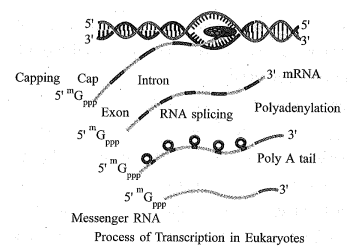
→ Hence, it is subjected to a process called splicing where the introns are removed and exons are joined in a defined order.
hnRNA undergoes additional processing called
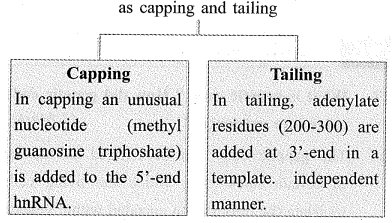
Image
→ It is the fully processed hnRNA, now called mRNA, that is transported out of the nucleus for translation.
→ The significance of such complexities is now beginning to be understood. The split-gene arrangements represent probably an ancient feature of the genome.
→ The presence of introns is reminiscent of antiquity, and the process of splicing represents the dominance of RNA-world.
→ In recent times, the understanding of RNA and RNA-dependent processes in the living system have assumed more importance.
Image

Need a full question paper?

Generate a complete, print-ready paper with questions like this in minutes — across 16+ boards, with answer keys.

Start Generating Free

Similar questions

Explain the following two components of Darwin's theory of natural selection.
  1. Variations.
  2. Formation of new species.
Explain the mechanism of DNA replication with the help of a replication fork. What role does the enzyme DNA-ligase play in a DNA replication fork?
What is adaptive radiation? Explain with examples.
Three water samples namely river water, untreated sewage water and secondary effluent discharged from a sewage treatment plant were subjected to BOD test. The samples were labelled A, B and C; but the laboratory attendant did not note which was which. The BOD values of the three samples A, B and C were recorded as 20mg/L, 8mg/L and 400mg/L, respectively. Which sample of the water is most polluted? Can you assign the correct label to each assuming the river water is relatively clean?
Explain various events during a menstrual cycle in detail. (Diagram is not necessary)
Explain: Population density
Draw a diagram of a male gametophyte of an angiosperm. Label any four parts. Why is sporopollenin considered the most resistant organic material?
How are assisted reproductive technologies helpful to humans? How are ZIFT and GIFT different from intrauterine transfers? Explain.
Answer the following questions:
What is amniocentesis and why there is a statutory ban on it?
  1. Name the respective forms in which the malarial parasite gains entry into
  1. Human body
  2. Body of female Anopheles
  1. Name the hosts where the sexual and the asexual reproductions of malarial parasite occur respectively.
  2. Name the toxin responsible for the appearance of symptoms of malaria in humans. Why do these symptoms occur periodically?