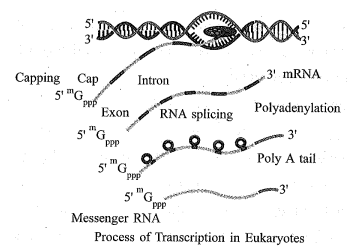
→ In eukaryotes, there are two additional complexities
(i) There are at least three RNA polymerases in the nucleus (in addition to the RNA polymerase found in the organelles). There is a clear cut division of labour. The RNA polymerase I transcribes rRNAs (28S, 18S, and 5.8S), whereas the RNA polymerase III is responsible for transcription of tRNA, 5srRNA, and snRNAs (small nuclear RNAs). The RNApolymerase II transcribes precursor of mRNA, the heterogeneous nuclear RNA (hnRNA).
(ii) The second complexity is that the primary transcripts contain both the exons and the introns and are non-functional.
→ Post-Transcriptional changes
→ Hence, it is subjected to a process called splicing where the introns are removed and exons are joined in a defined order.
hnRNA undergoes additional processing called
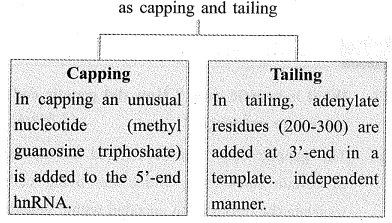
→ It is the fully processed hnRNA, now called mRNA, that is transported out of the nucleus for translation.
→ The significance of such complexities is now beginning to be understood. The split-gene arrangements represent probably an ancient feature of the genome.
→ The presence of introns is reminiscent of antiquity, and the process of splicing represents the dominance of RNA-world.
→ In recent times, the understanding of RNA and RNA-dependent processes in the living system have assumed more importance.