MCQ
In extrinsic semiconductors
  • A
    The conduction band and valence band overlap
  • B
    The gap between conduction band and valence band is more than $16 eV$
  • The gap between conduction band and valence band is near about $1 eV$
  • D
    The gap between conduction band and valence band will be $100 eV$  and more
Answer

Correct option: C.
The gap between conduction band and valence band is near about $1 eV$
c
(c)

Need a full question paper?

Generate a complete, print-ready paper with questions like this in minutes — across 16+ boards, with answer keys.

Start Generating Free

Similar questions

An electric charge $10^{-8}\  C$  is placed at the point $ (4\,m, 7\,m, 2\,m)$. At the point $(1\,m, 3\,m, 2\,m)$, the electric
A bar of iron is $10\, cm$ at $20°C$. At $19°C$ it will be ($\alpha$ of iron $= 11 \times 10^{-6}/°C$)
A circular disc of mass $2 \,kg$ and radius $10 \,cm$ rolls without slipping with a speed $2 \,m / s$. The total kinetic energy of disc is .......... $J$
Mobilities of electrons and holes in a sample of intrinsic Ge at room temperature are $0.35\,m^2/V-s$ and $0.18\,m^2/V-s$ respectively. If the electron and hole densities are each equal to $2.5 \times 10^{19}/m^3$, the Ge conductivity will be.....$S/m$
Two satellites $S_{1}$ and $S_{2}$ are revolving around a planet in the opposite sense in coplanar circular concentric orbits. At time $t=0$, the satellites are farthest apart. The periods of revolution of $S_{1}$ and $S_{2}$ are $3 \,h$ and $24 \,h$, respectively. The radius of the orbit of $S_{1}$ is $3 \times 10^{4} \,km$. Then, the orbital speed of $S_{2}$ as observed from
In a compound microscope the objective of ${f_o}$ and eyepiece of ${f_e}$ are placed at distance $L$ such that $L$ equals
A radioactive substance has an average life of $5$ hours. In a time of $5$ hours
A particle with ${10^{ - 11}}\,coulomb$ of charge and ${10^{ - 7}}\,kg$ mass is moving with a velocity of ${10^8}\,m/s$ along the $y$-axis. A uniform static magnetic field $B = 0.5\,Tesla$ is acting along the $x$-direction. The force on the particle is
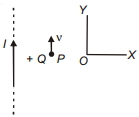
A charge $Q$ moves parallel to a very long straight wire carrying a current $l$ as shown. The force on the charge is
$Assertion$: A rigid disc rolls without slipping on a fixed rough horizontal surface with uniform angular velocity. Then the acceleration of lowest point on the disc is zero.
$Reason$ : For a rigid disc rolling without slipping on a fixed rough horizontal surface, the velocity of the lowest point on the disc is always zero