MCQ
In Fig. if $AB \| CD$, then $x =$
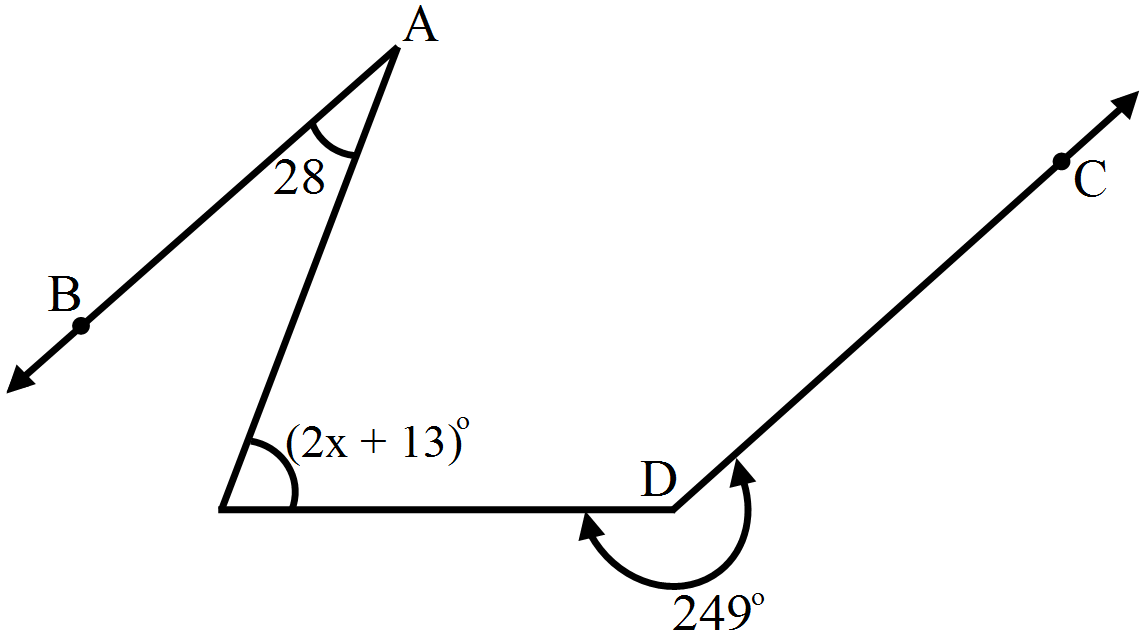
- A$32$
- ✓$42$
- C$52$
- D$31$
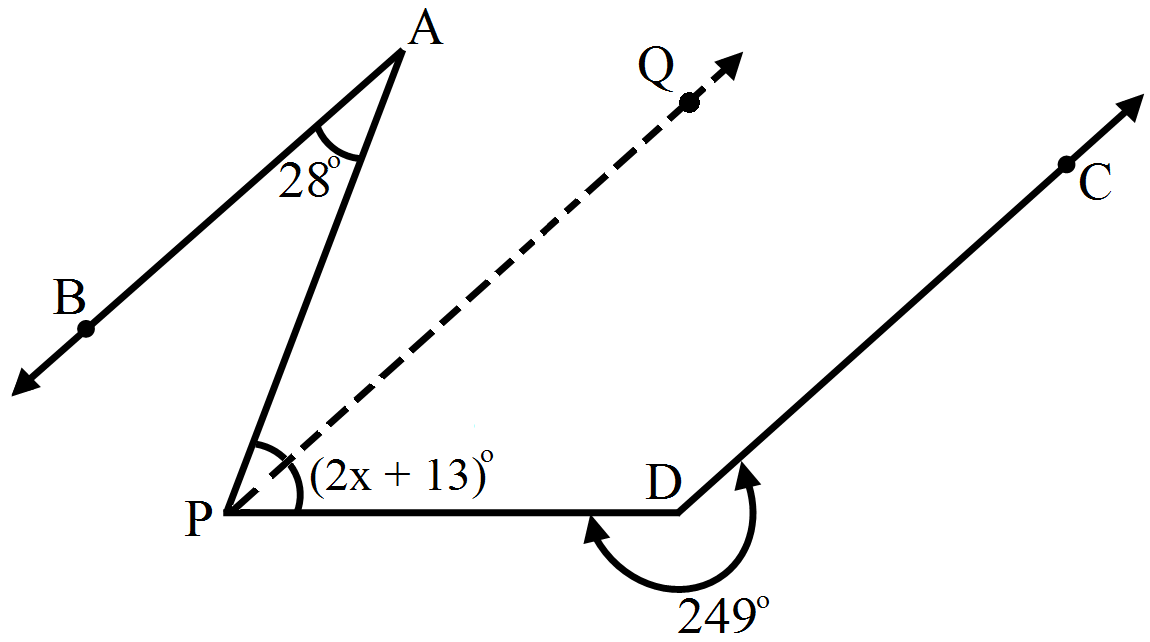
Construction: Draw a line $PQ$ parallel to $AB$ which is also parallel to $CD$
$\angle \text{CDP}+\text{Reflex}\angle \text{CDP}=360^\circ [$Complete angle$]$
$\therefore \text{CDP}+249^\circ=360^\circ$
$\Rightarrow \angle \text{CDP}=111^\circ$
Since,$ PQ \| AB$
$\therefore \angle \text{BAP}=\angle \text{APQ} [$Alternate angles$]$
$\Rightarrow \angle \text{BAP}=28^\circ$
Now, $\angle \text{APQ}+\angle \text{QPD}=\angle \text{APD}$
$\Rightarrow 28^\circ+\angle \text{QPD}=(2\text{x}+13)^\circ$
$\Rightarrow \angle \text{QPD}=(2\text{x}+13)^\circ-28^\circ$
Since, $PQ \| CD$
$\therefore \angle \text{QPD}+\angle \text{CDP}=180^\circ [$Angles on the same side of a transversal line are supplementary$]$
$\Rightarrow (2\text{x}+13)^\circ-286\circ+111^\circ=180^\circ$
$\Rightarrow 2\text{x}+13-28+111=180$
$\Rightarrow 2\text{x}=84$
$\Rightarrow \text{x}=42$
Hence, the correct answer is option $(b).$
Generate a complete, print-ready paper with questions like this in minutes — across 16+ boards, with answer keys.