Question
In Figure ABCD is a regular hexagon, which vectors are:
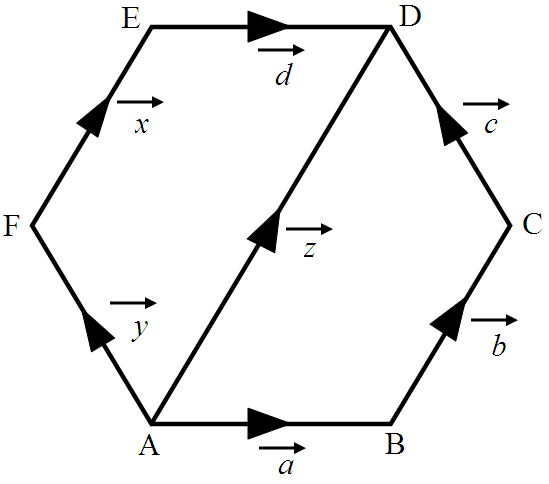
  1. Collinear.
  2. Equal.
  3. Co-initial.
  4. Collinear but not equal.

Answer

  1. Vectors having the same or parallel supports are called collinear vector. In the given figure the collinear vectors are,

$\vec{\text{a}},\ \vec{\text{d}};\ \vec{\text{x}},\ \vec{\text{z}},\ \vec{\text{b}};\ \vec{\text{c}},\ \vec{\text{y}}$

  1. vectors having the same magnitude and direction are called equal vector. In the given figure the equal vectors are,

$\vec{\text{b}},\ \vec{\text{x}};\ \vec{\text{c}},\ \vec{\text{y}};\ \vec{\text{a}},\ \vec{\text{d}}$

  1. Vectors having the same initial point are called co-initial vector. In the given figure the co-initial vectors are,

$\vec{\text{a}},\ \vec{\text{y}},\ \vec{\text{z}}$

  1. The vectors which are collinear but not equal are $\vec{\text{b}},\ \vec{\text{z}};\ \vec{\text{x}},\ \vec{\text{z}}$

Need a full question paper?

Generate a complete, print-ready paper with questions like this in minutes — across 16+ boards, with answer keys.

Start Generating Free

Similar questions

Solve the following differential equations:

$\frac{\text{dy}}{\text{dx}}=\text{y}\tan\text{ x, y}(0)=1$

Show that $\text{f}(\text{x})=\frac{1}{1+\text{x}^2}$ is decreases in the interval $[0,\infty)$ and increases in the interval $(-\infty,0].$
If $\text{y}=\cos^{-1}\Big\{\frac{2\text{x}-3\sqrt{1-\text{x}^2}}{\sqrt{13}}\Big\},$ find $\frac{\text{dy}}{\text{dx}}.$
Let Z be the set of all integers and Z0 be the set of all non-zero integers. Let a relation R on Z × Z0 be defined as (a, b)R(c, d) ⇔ ad = bc for all (a, b), (c, d) ∈ Z × Z0, Prove that R is an equivalence relation on Z × Z0.
Solve the following differential equation
$\text{C}(\text{x})=2+0.15\text{x},\text{C}(0)=100$
Find the distance of the point (2, 12, 5) from the point of intersection of the line $\vec{\text{r}}=2\hat{\text{i}}-4\hat{\text{j}}+2\hat{\text{k}}+\lambda(3\hat{\text{i}}+4\hat{\text{j}}+2\hat{\text{k}})$ and $\vec{\text{r}}\cdot(\hat{\text{i}}-2\hat{\text{j}}+\hat{\text{k}})=0.$
Differentiate the following functions with respect to x:
$\frac{3\text{x}^2\sin\text{x}}{\sqrt{7-\text{x}^2}}$
By examining the chest X-ray, probability that T.B. is detected when a person is actually suffering is 0.99. The probability that the doctor diagnoses incorrectly that a person has T.B. on the basic of X-ray is 0.001. In a certain city 1 in 1000 persons suffers from T.B. A person is selected at random is diagnosed to have T.B. what is the chance that he actually has T.B.?
Evaluate the following integrals:
$\int\limits^\pi_0\sin^{100}\text{x}\cos^{101}\text{x dx}$
An insurance company insured 3000 scooters, 4000 cars and 5000 trucks. The probabilities of the accident involving a scooter, a car and a truck are 0.02, 0.03 and 0.04 respectively. One of the insured vehicles meet with an accident. Find the probability that it is a,
  1. Scooter.
  2. Car.
  3. Truck.