Question
In Figure lines AB and CD intersect at O. If $\angle AOC + \angle BOE = {70^ \circ }$  and $\angle BOD = {40^ \circ }$,find $\angle BOE$ and reflex $\angle COE$
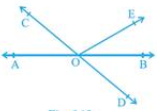
Fig.6.1.png

Answer

We are given that ​​​​​​$\angle$AOC + $\angle$BOE = 70° and $\angle$BOD = 40°
We need to find $\angle$BOE and reflex $\angle$COE
From the given figure, we can conclude that $\angle$AOE and $\angle$BOE form a linear pair.
We know that sum of the angles of a linear pair is 180°
$\therefore$ $\angle$AOE + $\angle$BOE = 180°​​​​​​​
$\because$ $\angle$AOE = $\angle$AOC + $\angle$ COE
$\therefore$ $\angle$AOC + $\angle$COE + $\angle$BOE = 180°​​​​​​​
$\therefore$ $\angle$AOC + $\angle$BOE + $\angle$COE = 180°​​​​​​​
$\Rightarrow$ 70°​​​​​​​ + $\angle$COE = 180°​​​​​​​
$ \Rightarrow$ $\angle$COE = 180° - 70°
= 110°
Reflex $\angle$COE = 360° - $\angle$COE
= 360° - 110°
= 250°
$\angle$AOC = $\angle$BOD (Vertically opposite angles), or
$\angle$BOD + $\angle$BOE = 70
But, we are given that $\angle$BOD = 40°.
 40° + $\angle$BOE = 70°
$\angle$BOE = 70° - 40°
= 30°.
Therefore, we can conclude that  Reflex $\angle$COE = 250° and $\angle$BOE = 30°

Need a full question paper?

Generate a complete, print-ready paper with questions like this in minutes — across 16+ boards, with answer keys.
Start Generating Free

Similar questions

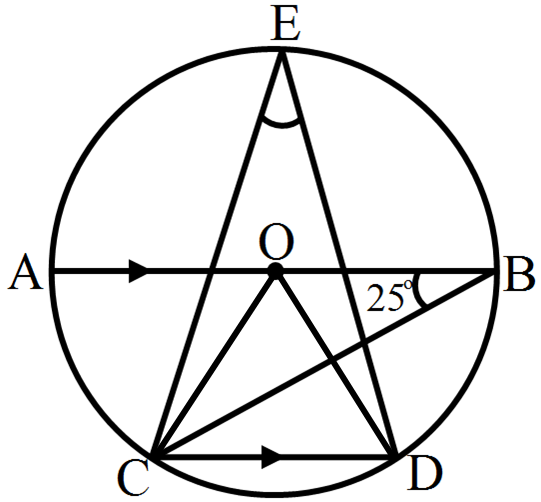
In the adjoining figure, O is the centre of a circle. Chord CD is parallel to diameter AB. If $\angle\text{ABC}=25^\circ,$ calculate $\angle\text{CED}.$
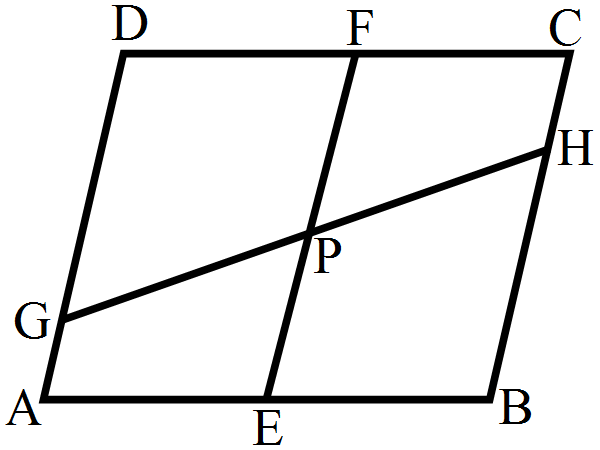
In the adjoining figure, ABCD is a || gm in which E and F are the midpoints of AB and CDrespectively. If GH is a line segment that cuts AD, EF and BC at G, P and H respectively, prove that GP = PH.
The area of a rhombus is $480\ cm^2,$ and one of its diagonals measures $48\ cm. $Find:
  1. The length of the other diagonal.
  2. The length of each of its sides.
  3. Its perimeter.
The midpoints of the sides AB, BC, CD and DA of a quadrilateral ABCD are joined to form a quadrilateral. If AC = BD and $\text{AC}\perp\text{BD}$ then prove that the quadrilateral formed is a square.
Draw the graph of the equation $\frac{\text{x}}{3}+\frac{\text{y}}{4}=1.$ Also, find the area of the triangle formed by the line and the coordinates axes.
In a $\triangle\text{ABC},\angle\text{ABC}=\angle\text{ACB}$ and the bisectors of $\angle\text{ABC}$ and $\angle\text{ACB}$ intersect at O such that $\angle\text{BOC}=120^\circ.$ Show that $\angle\text{A}=\angle\text{B}=\angle\text{C}=60^\circ.$
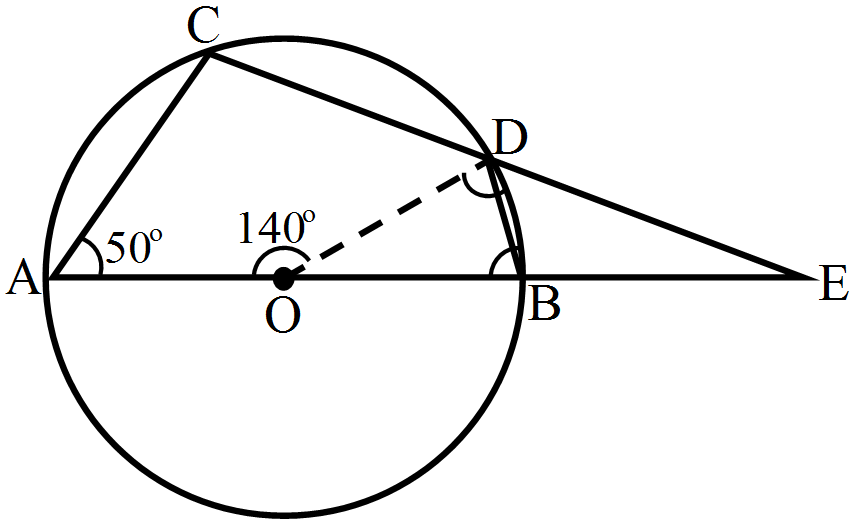
In the given figure, O is the centre of a circle. If $\angle\text{AOC}=140^\circ$ and $\angle\text{CAB}=50^\circ,$ calculate
  1. $\angle\text{EDB}$
  2. $\angle\text{EBD}$
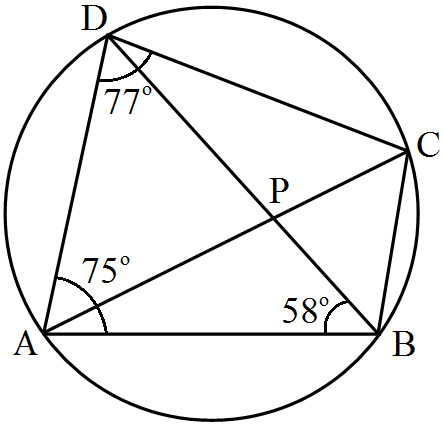
In the given figure, ABCD is a cyclic quadrilateral in which $\angle\text{BAD} = 75^\circ,\ \angle\text{ABD} = 58^\circ$ and $\angle\text{ADC} = 77^\circ, $ AC and BD intersect at P. Then, find $\angle\text{DPC}.$
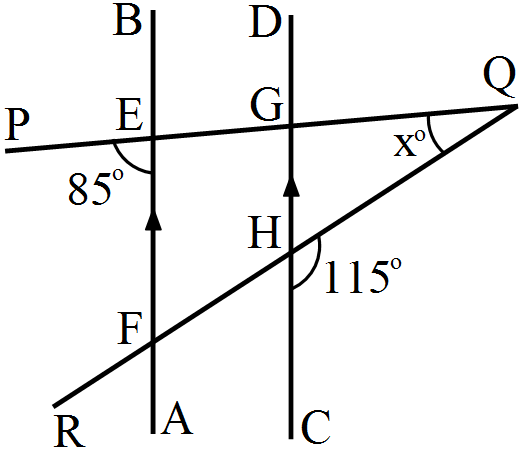
In the given figure, AB || CD. Find the value of x.
A well with inside diameter $10m$ is dug $8.4m$ deep. Earth taken out of it is spread all around it to a width of $7.5m$ to form an embankment. Find the height of the embankment.