MCQ
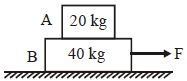
In figure, the coefficient of friction between the floor and the block $B$ is $0.2$ and  between blocks $A$ and $B$ is $0.3$. ........ $N$  is the maximum horizontal force $F$ can be  applied to the block $B$ so that both blocks move together .
  • A
    $60$
  • B
    $120$
  • C
    $240$
  • $300$

Answer

Correct option: D.
$300$
d
Common acceleration is

$a=\frac{\mu_{A} m_{A} g}{m_{B}}=0.3 \times 10$

$a=3 \mathrm{m} / \mathrm{s}^{2}$

and

$\mathrm{F}-0.2(20+40) \mathrm{g}=(20+40) \mathrm{a}$

$\Rightarrow \mathrm{F}-120=60 \times 3$

$\Rightarrow \mathrm{F}=300 \mathrm{N}$

Need a full question paper?

Generate a complete, print-ready paper with questions like this in minutes — across 16+ boards, with answer keys.

Start Generating Free

Similar questions

The energy which an ${e^ - }$ acquires when accelerated through a potential difference of $1 \,volt$ is called
The range of a particle when launched at an angle of ${15^o}$ with the horizontal is $1.5 \,km$. What is the range of the projectile when launched at an angle of ${45^o}$ to the horizontal ........ $km$
A sphere contracts in volume by $0.01 \%$ when taken to the bottom of sea $1 \,km$ deep. Find Bulk modulus of the material of sphere ........... $N / m ^2$
The fundamental frequency of a sonometer with a weight of $4\,kg$ is $256\,Hz$ . The weight required to produce its octave is .... $kg-wt$
What must be the lengths of steel and copper rods at $0^o C$ for the difference in their lengths to be $10\,cm$ at any common temperature? $(\alpha_{steel}=1.2 \times {10^{-5}} \;^o C^{-1})$ and $(\alpha_{copper} = 1.8 \times 10^{-5} \;^o C^{-1})$
A bullet of mass $20 \,g$ leaves a riffle at an initial speed $100 \,m / s$ and strikes a target at the same level with speed $50 \,m / s$. The amount of work done by the resistance of air will be ......... $J$
A person carries a weight on his head for distance r. He has to do maximum work. When he takes the object:
How much work is required to making a soap bubble solution whose radius is r?
A heavy stone is thrown from a cliff of height $h$ with a speed $\nu.$ The stone will hit the ground with maximum speed if it is thrown:
A particle is forced to move on a straight line path. It returns to the starting point after $10$ seconds. The total distance covered by the particle during this time is $20m.$ Which of the following statements is false regarding the motion of the particles?