Question
✓
Answer
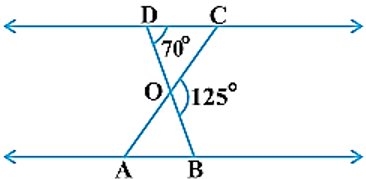
From the given figure,
$\angle DOC + 125^\circ = 180^\circ $[linear pair]
$\angle DOC = 55^\circ$
Now, in $\triangle$DOC,
$\angle DCO + \angle ODC + \angle DOC = 180^\circ$[angle sum property of a triangle]
$\angle DCO +70^\circ + 55^\circ=180^\circ$
$\angle DCO = 55^\circ$
Now, $\triangle ODC \cong \triangle OBA$ [given]
$\therefore \angle OAB = \angle OCD = 55^\circ$
$\angle DOC + 125^\circ = 180^\circ $[linear pair]
$\angle DOC = 55^\circ$
Now, in $\triangle$DOC,
$\angle DCO + \angle ODC + \angle DOC = 180^\circ$[angle sum property of a triangle]
$\angle DCO +70^\circ + 55^\circ=180^\circ$
$\angle DCO = 55^\circ$
Now, $\triangle ODC \cong \triangle OBA$ [given]
$\therefore \angle OAB = \angle OCD = 55^\circ$
Need a full question paper?
Generate a complete, print-ready paper with questions like this in minutes — across 16+ boards, with answer keys.
Explore more
Similar questions
The following data gives the information on the observed lifetimes (in hours) of $225$ electrical components:
Determine the modal lifetimes of the components.
→| Lifetimes (in hours) | $0-20$ | $20-40$ | $40-60$ | $60-80$ | $80-100$ | $100-120$ |
| Frequency | $10$ | $35$ | $52$ | $61$ | $38$ | $29$ |
Graphically, find whether the following pair of equations has no solution, unique solution or infinitely many solutions:
$5x - 8y + 1 = 0; ...(i)$
$3x -$ $\frac{24}{5}$$y$ $+$ $\frac{3}{5}$ $= 0 ...(ii)$
→$5x - 8y + 1 = 0; ...(i)$
$3x -$ $\frac{24}{5}$$y$ $+$ $\frac{3}{5}$ $= 0 ...(ii)$
Find:
$8^{th}$ term of the A.P. $117, 104, 91, 78, ......$
→$8^{th}$ term of the A.P. $117, 104, 91, 78, ......$
In FIg. check whether $AD$ is the bisector of $\angle\text{A}$ of $\triangle\text{ABC}$ in the following.
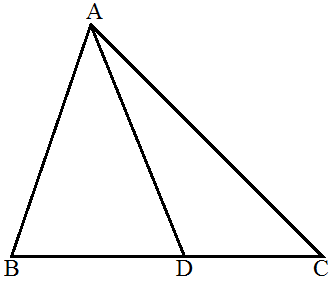
$AB = 5\ cm, AC = 12\ cm, BD = 2.5\ cm$ and $BC = 9\ cm.$
→$AB = 5\ cm, AC = 12\ cm, BD = 2.5\ cm$ and $BC = 9\ cm.$
The difference between the circumference and radius of a circle is $37\ cm$. Using $\pi=\frac{22}{7},$ find the circumference of the circle.
→Express the following in terms of trigonometric ratios of angles lying between $0^\circ $ and $45^\circ .$
$\text{cosec }54^\circ+\sin72^\circ$
→$\text{cosec }54^\circ+\sin72^\circ$
Find a quadratic polynomial, the sum and product of whose zeroes are $\frac { 1 } { 4 } , - 1$ respectively.
→A carton consists of $100$ shirts of which $88$ are good and $8$ have minor defects. Rohit, a trader, will only accept the shirts which are good. But kamal, an another trader, will only reject the shirts which have major defects. One shirt is drawn at random from the corton. What is the probability that it is acceptable to.
→-
Rohit.
-
Kamal.
Prove that:
$\text{cosec}(67^\circ+\theta)-\sec(23^\circ-\theta)=0$
→$\text{cosec}(67^\circ+\theta)-\sec(23^\circ-\theta)=0$
Are the given numbers form an $AP?$ If they form an $AP$, write the next two terms: $1, 1, 1, 2, 2, 2, 3, 3, 3, ...$
→