MCQ
In Figure, $\triangle\text{ABC}$ is an isosceles triangle, right-angled at $C$. Therefore.
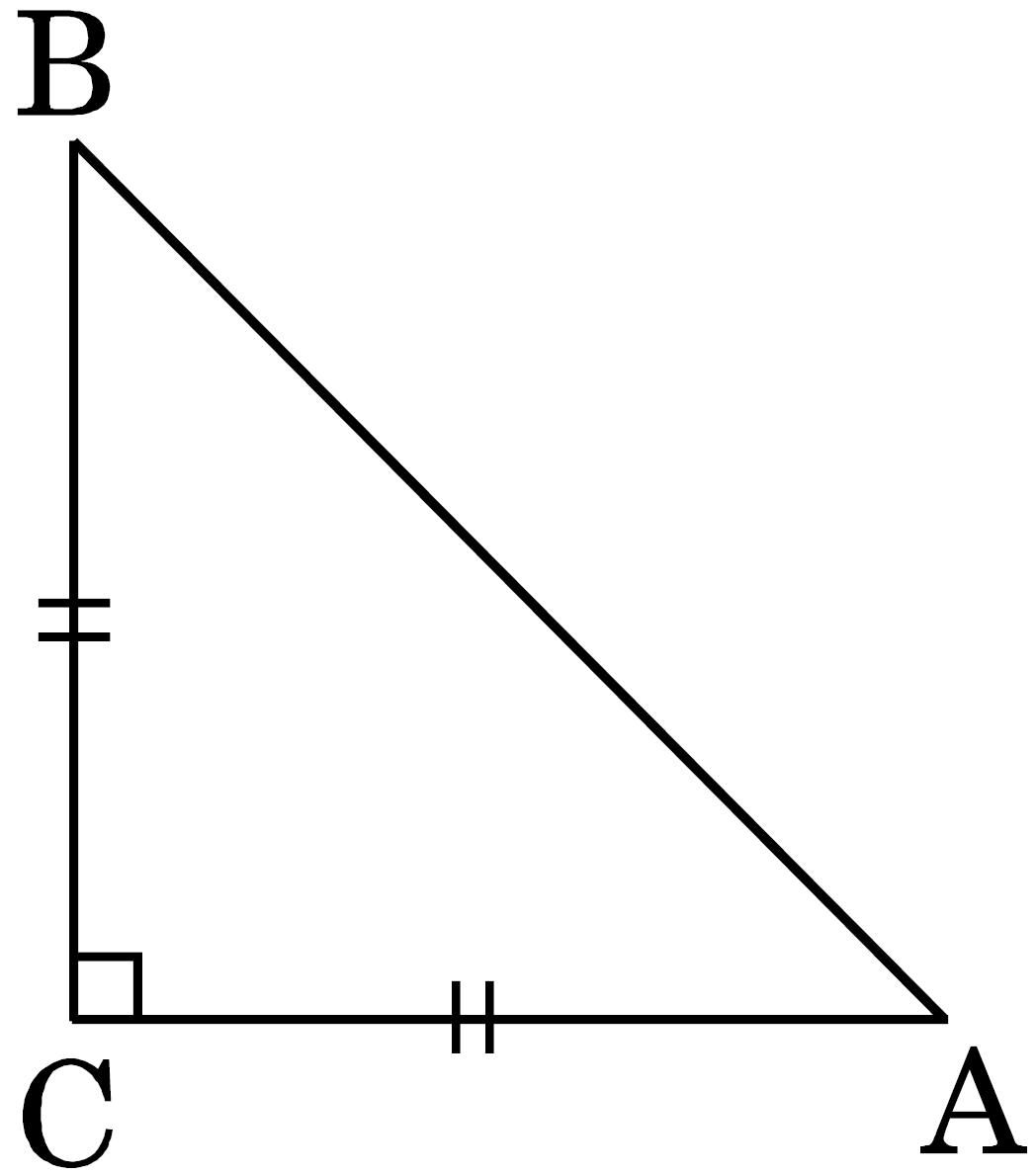
- ✓$\mathrm{AB}^2=2 \mathrm{AC}^2$
- B$\mathrm{BC}^2=2 \mathrm{AB}^2$
- C$\mathrm{AC}^2=2 \mathrm{AB}^2$
- D$\mathrm{AB} 2=4 \mathrm{AC} 2$
Generate a complete, print-ready paper with questions like this in minutes — across 16+ boards, with answer keys.
|
Mark
|
$30-35$ | $35-40$ | $40-45$ | $45-50$ | $50-55$ | $55-60$ | $60-65$ |
|
Frequency
|
$10$ | $15$ | $18$ | $22$ | $23$ | $8$ | $4$ |