MCQ
In fire extinguisher, pyrene is
- A$C{O_2}$
- ✓$CC{l_4}$
- C$C{S_2}$
- D$CHC{l_3}$
It forms highly poisonous phosgene gas
$CC{l_4} + {H_2}O \to \mathop {COC{l_2}}\limits_{{\rm{Phosgene}}} + 2HCl$
Generate a complete, print-ready paper with questions like this in minutes — across 16+ boards, with answer keys.
$2NO_2(g) + O_3(g) \to N_2O_5(g) + O_2(g)$
rate law is $R = K\, [NO_2]' [O_3]'$.
Which of these possible reaction mechanisms is consistent with the rate law?
Mechanism $I :$
$NO_2(g) + O_3(g) \to NO_3(g) + O_2(g)$ (slow)
$NO_3(g) + NO_2(g) \to N_2O_5(g)$ (fast)
Mechanism $II :$
$O_3(g) \rightleftharpoons O_2(g) + [O]$ (fast)
$NO_2(g) + [O] \to NO_3$ (slow)
$NO_3(g) + NO_2(g) \to N_2O_5$ (fast)
$Cl_2 + 2Y^-\to 2Cl^-+ Y_2$
The incorrect match regarding above reaction is
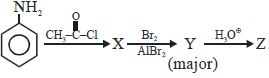
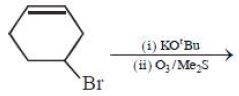
$(i)$ Ionization $(ii)$ Hydrate $(iii)$ Coordination $(iv)$ Geometrical $(v)$ Optical
Which of the above isomerisms are exhibited by $[Cr(NH_3)_2 (OH)_2 Cl_2]^-$?