In forced oscillations, a particle oscillates simple harmonically with frequency equal to
Easy


Download our appand get started for free
Experience the future of education. Simply download our apps or reach out to us for more information. Let's shape the future of learning together!No signup needed.*
Similar Questions
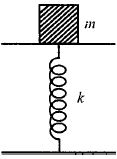
- 1A mass $m = 1.0\,kg$ is put on a flat pan attached to a vertical spring fixed on the ground. The mass of the spring and the pan is negligible. When pressed slightly and released, the mass executes simple harmonic motion. The spring constant is $500\,N/m.$ What is the amplitude $A$ of the motion, so that the mass $m$ tends to get detached from the pan ? (Take $g = 10\,m/s^2$ ). The spring is stiff enough so that it does not get distorted during the motion.View Solution
- 2A rod of mass $‘M’$ and length $‘2L’$ is suspended at its middle by a wire. It exhibits torsional oscillations; If two masses each of $‘m’$ are attached at distance $‘L/2’$ from its centre on both sides, it reduces the oscillation frequency by $20\%$. The value of ratio $m/M$ is close toView Solution
- 3The period of simple pendulum is measured as $T$ in a stationary lift. If the lift moves upwards with an acceleration of $5\, g$, the period will beView Solution
- 4A simple pendulum is suspended in a car. The car starts moving on a horizontal road according to equation $x\, = \,\frac{g}{2}\,\sqrt 3 {t^2}$. Find the time period of oscillation of the pendulum.View Solution
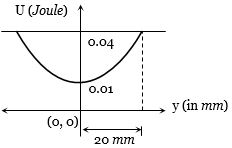
- 5View SolutionThe variation of potential energy of harmonic oscillator is as shown in figure. The spring constant is
- 6A spring is stretched by $0.20\, m$, when a mass of $0.50\, kg$ is suspended. When a mass of $0.25\, kg$ is suspended, then its period of oscillation will be .... $\sec$ $(g = 10\,m/{s^2})$View Solution
- 7Column $I$ gives a list of possible set of parameters measured in some experiments. The variations of the parameters in the form of graphs are shown in Column $II$. Match the set of parameters given in Column $I$ with the graph given in Column $II$. Indicate your answer by darkening the appropriate bubbles of the $4 \times 4$ matrix given in the $ORS$.View Solution
Column $I$ Column $II$ $(A)$ Potential energy of a simple pendulum (y axis) as a function of displacement ( $\mathrm{x}$ axis) $Image$ $(B)$ Displacement (y axis) as a function of time (x axis) for a one dimensional motion at zero or constant acceleration when the body is moving along the positive $\mathrm{x}$-direction $Image$ $(C)$ Range of a projectile (y axis) as a function of its velocity ( $\mathrm{x}$ axis) when projected at a fixed angle $Image$ $(D)$ The square of the time period (y axis) of a simple pendulum as a function of its length ( $\mathrm{x}$ axis) $Image$ 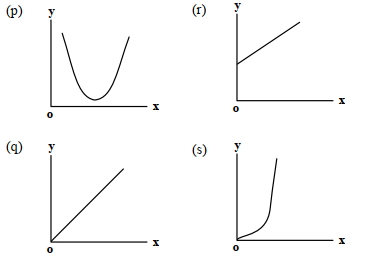
- 8The function ${\sin ^2}(\omega t)$ representsView Solution
- 9Two particles $P$ and $Q$ start from origin and execute Simple Harmonic Motion along $X-$axis with same amplitude but with periods $3$ seconds and $6$ seconds respectively. The ratio of the velocities of $ P$ and $Q$ when they meet isView Solution
- 10pendulum made of a uniform wire of cross sectional area $A$ has time period $T$. When an additional mass $M$ is added to its bob, the time period changes to $T_M$. If the Young's modulus of the material of the wire is $Y$ then $\frac{1}{Y}$ is equal to : ($g$ = gravitational acceleration)View Solution