MCQ
In gamma ray emission from a nucleus
  • there is no change in the proton number and the neutron number
  • B
    only the neutron number changes
  • C
    only the proton number changes
  • D
    both the neutron number and the proton number change

Answer

Correct option: A.
there is no change in the proton number and the neutron number
a
There is no change in the proton number and the neutron number as the $\gamma$ -emission takes place as a result of excitation or de-excitation of nuclei. $\gamma$ -rays have no charge or mass.

Need a full question paper?

Generate a complete, print-ready paper with questions like this in minutes — across 16+ boards, with answer keys.
Start Generating Free

Similar questions

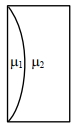
Curved surfaces of a plano-convex lens of refractive index $\mu_{1}$ and a plano-concave lens of refractive index $\mu_{2}$ have equal radius of curvature as shown in figure. Find the ratio of radius of curvature to the focal length of the combined lenses.
Compared to the electric force between two elec- trons, the electrostatic force between two protons is:
A parallel plate capacitor of capacitance $C$ is connected to a battery and is charged to a potential difference $V$. Another capacitor of capacitance $2C$ is similarly charged to a potential difference $2V$. The charging battery is now disconnected and the capacitors are connect in parallel to each other in such a way that the positive terminal of one is connected to the negative terminal of the other. The final energy of the configuration is
The band spectra $($characteristic of molecular species$)$ is due to emission of radiation:
Two metal spheres of capacitance $C_1$ and $C_2$ carry some charges. They are put in contact and then separated. The final charges $Q_1$ and $Q_2$ on them will satisfy
The momentum in mechanics is expressed as $m \times \,v$. The analogous expression in electricity is
Assertion : The electromagnetic waves of shorter wavelength can travel longer distances on earth's surface than those of longer wavelengths.
Reason : Shorter the wavelength, the larger is the velocity of wave propagation.
A person uses spectacles of power $+2D.$ He is suffering from
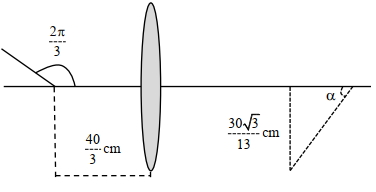
A rod of length $2 cm$ makes an angle $\frac{2 \pi}{3}$ rad with the principal axis of a thin convex lens. The lens has a focal length of $10 cm$ and is placed at a distance of $\frac{40}{3} cm$ from the object as shown in the figure. The height of the image is $\frac{30 \sqrt{3}}{13} cm$ and the angle made by it with respect to the principal axis is $\alpha$ rad. The value of $\alpha$ is $\frac{\pi}{n} rad$, where $n$ is. . . . .
For a transistor to act as a switch, it must be operated in