MCQ
In $\gamma\ \text{ray}$ emission from a nucleus:
  • A
    Only the proton number changes.
  • B
    Both the neutron number and the proton number change.
  • C
    There is no change in the proton number and the neutron number.
  • D
    Only the neutron number changes.

Answer

  1. There is no change in the proton number and the neutron number.

Need a full question paper?

Generate a complete, print-ready paper with questions like this in minutes — across 16+ boards, with answer keys.

Start Generating Free

Similar questions

A biconvex lens of focal length f is cut into two identical plano convex lenses. The focal length of each part will be
A convex lens forms a real image of a point object placed on its principal axis. If the upper half of the lens is painted black:
  1. The image will be shifted downward.
  2. The image will be shifted upward.
  3. The image will not be shifted.
  4. The intensity of the image will decrease.

Thomson coefficient of a conductor is 10μV/K. The two ends of it are kept at 50 and 60 respectively. Amount of heat absorbed by the conductor when a charge of 10C flows through it is

(a) 1000 J

(b) 100 J

(c) 100 mJ

(d) 1 mJ

The relation between Faraday constant (F), chemical equivalent (E) and electrochemical equivalent (Z) is

(a) F = EZ

(b)

(c)  

(d)

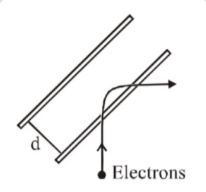
A problem of practical interest is to make a beam of electrons turn at 90° corner. This can be done with the parallel plates shown in figure. An electron with kinetic energy 8.0 × 10⁻¹⁷J enters through a small hole in the bottom plate. The strength of electric field that is needed if the electron is to emerge from an exit hole 1.0cm away from the entrance hole, traveling at right angles to its original direction is _______ ×105N/ C.

The truth table given in figure represents:
A B Y
0 0 0
0 1 1
1 0 1
1 1 1

If a steady current of 4 amp maintained for 40 minutes, deposits 4.5 gm of zinc at the cathode and then the electro chemical equivalent will be

(a) 51  

(b) 28 

(c) 32  

(d) 47  

The focal lengths of the objective and eye lens of a microscope are 4 cm and 8 cm respectively and the distance of the object from the objective is 4.5 cm , then the magnifying power will be :
The resistance coils in a resistance box are made of double folded wire so that their.

A parallel plate capacitor having a plate separation of 2 mm is charged by connecting it to a 300 V supply. The energy density is

(a) 0.01 J/m3

(b) 0.1 J/m3

(c) 1.0 J/m3

(d) 10 J/m3