MCQ
In $\gamma\ \text{ray}$ emission from a nucleus:
  • A
    Only the proton number changes.
  • B
    Both the neutron number and the proton number change.
  • There is no change in the proton number and the neutron number.
  • D
    Only the neutron number changes.

Answer

Correct option: C.
There is no change in the proton number and the neutron number.

Need a full question paper?

Generate a complete, print-ready paper with questions like this in minutes — across 16+ boards, with answer keys.
Start Generating Free

Similar questions

The slope of plate characteristic of a vacuum diode is $2 \times 10^{-2} mA / V$. The plate resistance of diode will be
The dielectric constant $k$ of an insulator cannot be
The magnetic flux linked with a circuit of resistance $100\, \Omega$ increases from $10$ to $60$ webers. The amount of induced charge that flows in the circuit is (in coulomb)
A electron experiences a force $\left( {4.0\,\hat i + 3.0\,\hat j} \right)\times 10^{-13} N$ in a uniform magnetic field when its velocity is $2.5\,\hat k \times \,{10^7} ms^{-1}$. When the velocity is redirected and becomes $\left( {1.5\,\hat i - 2.0\,\hat j} \right) \times {10^7}$, the magnetic force of the electron is zero. The magnetic field $\vec B$ is :
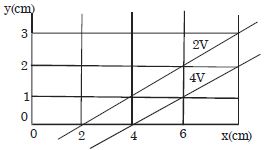
Figure shows two equipotential lines in $x, y$ plane for an electric field. The scales are marked. The $x-$ component $E_x$ and $y$ -component $E_y$ of the electric field in the space between these equipotential lines are respectively :-
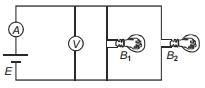
Two identical bulbs are connected in parallel across an ideal source of emf $E$. The ammeter $A$ and voltmeter $V$ are ideal. If bulb $B_2$ gets fused, then
The e.m.f. of a cell is $E\, volts$ and internal resistance is $r$ $ohm$. The resistance in external circuit is also $r$ $ohm$. The p.d. across the cell will be
Fraunhofer lines are produced by
Three concentric metallic spherical shells of radii $R, 2 R, 3 R$, are given charges $Q_1, Q_2, Q_3$, respectively. It is found that the surface charge densities on the outer surfaces of the shells are equal. Then, the ratio of the charges given to the shells, $Q_1: Q_2: Q_3$, is
In $Y.D.S.E.$ using red and blue lights of wavelengths $7800\,\mathop A\limits^o $ and $5200\,\mathop A\limits^o $ $n^{th}$ red fringe coincides with $(n + 1)^{th}$ blue fringe value of $n$ is