Question
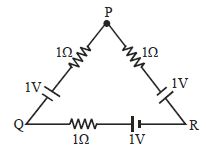
In given circuit find potential difference between $P$ and $Q$ .................. $V$
Answer

a
$\mathrm{I}=\frac{3}{3}=1 \mathrm{\,A},$ from kirchoff's rule

$\mathrm{V}_{\mathrm{P}}+1-1=\mathrm{V}_{\mathrm{Q}}$

$\mathrm{V}_{\mathrm{P}}-\mathrm{V}_{\mathrm{Q}}=0$

Need a full question paper?

Generate a complete, print-ready paper with questions like this in minutes — across 16+ boards, with answer keys.
Start Generating Free

Similar questions

When the temperature of a gas is raised from $30^o C$ to $90^o C$ , the percentage increase in the $r.m.s.$ velocity of the molecules will be
A galvanometer gives full scale deflection with $0.006$ A current. By connecting it to a $4990 \ \Omega$ resistance, it can be converted into a voltmeter of range $0-30 \ V$. If connected to a $\frac{2 n }{249} \Omega$ resistance, it becomes an ammeter of range $0-1.5 \ A$. The value of $n$ is:
The length of a potentiometer wire is $1200\; \mathrm{cm}$ and it carries a current of $60 \;\mathrm{mA}$. For a cell of $emf\;5\; \mathrm{V}$ and intemal resistance of $20\; \Omega,$ the null point on it is found to be a $1000\; \mathrm{cm} .$ The resistance of whole wire is .............. $\Omega$
A particle of mass $2 / 3 kg$ with velocity $v=-15 \,m / s$ at $t=-2 \,s$ is acted upon by a force $F=k-\beta t^{2}$. Here, $k=8 \,N$ and $\beta =2 \,N / s ^{2}$. The motion is one-dimensional. Then, the speed at which the particle acceleration is zero again, is ........... $m/s$
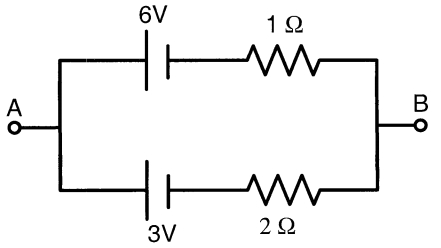
Two batteries of different emfs and different internal resistances are connected as shown. The voltage across $A B$ in volts is
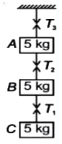
The value of $\frac{T_3}{T_1}$ is .............
A simple harmonic oscillator has an amplitude $A$ and time period $6 \pi$ second. Assuming the oscillation starts from its mean position, the time required by it to travel from $x=A$ to $x=\frac{\sqrt{3}}{2} A$ will be $\frac{\pi}{x} s,$ where $x= ....... :$
A particle is moving in a straight line and passes through a point $O$ with a velocity of $6\;m{s^{ - 1}}.$ The particle moves with a constant retardation of $2\;m{s^{ - 2}}\;$ for $4$ s and there after moves with constant velocity. How long after leaving $O$ does the particle return to $O$..........$s$
A bullet of mass $25\,g$ moving with a velocity of $200\,m/s$ is stopped within $5\,cm$ of the target. The average resistance offered by the target is ............... $\mathrm{kN}$
The wavelenghts of ${K_\alpha }$ $x-$ rays of two metals $'A'$ and $'B'$ are $\frac{4}{{1875R}}$ and $\frac{1}{{675R}}$ respectively, where $'R'$ is rydberg constant. The number of elements lying between $'A'$ and $'B'$ according to their atomic numbers is