MCQ
In human body which one of the following is anatomically correct?
- ACollar bones $- 3$ pairs
- BKidney $-2$ pairs
- CCranial nerves $-10$ pairs
- ✓Floating ribs $- 2$ pairs
Generate a complete, print-ready paper with questions like this in minutes — across 16+ boards, with answer keys.
$\begin{array}{|l|l|} \hline Col\,\,A & Col\,\,B \\ \hline 1.\,\,Species & P.\,\,Solanum \\ \hline 2.\,\,Genus & Q.\,\,Leo \\ \hline 3.\,\,Family & R.\,\,Polymoniales \\ \hline 4.\,\,Order & S.\,\,Felidae \\ \hline \end{array}$
Types of leucocytes Function
$A.$ Neutrophils $1.$ Heparin and histamine secretion
$B.$ Basophils $2.$ Antibodies formation
$C.$ Acidophils $3.$ Scavanger
$D.$ Monocytes $4.$ Phagocytes
$E.$ Lymphocytes $5.$ Antiallergic and healing of wounds
The correct pairing sequence is
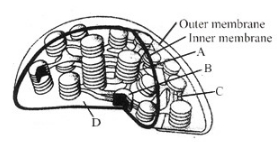
| | Column I | | Column II |
| A. | Molecular oxygen. | i | $\alpha $ Ketoglutaric acid. |
| B. | Electron acceptor. | ii | hydrogen acceptor. |
| C. | Pyruvate dehydrogenase. | iii | cytochrome C. |
| D. | Decarboxylation. | iv | acetyl Co A. |