MCQ
In hydrogen atom, when electron jumps from second to first orbit, then energy emitted is
  • A
    $-13.6\, eV$
  • B
    $-27.2\, eV$
  • C
    $-6.8\, eV$
  • None of these

Answer

Correct option: D.
None of these
d
${E_{{n_1} \to {n_2}}} = - 13.6\left[ {\frac{1}{{n_2^2}} - \frac{1}{{n_1^2}}} \right];{n_1} = 2$ & ${n_2} = 1$

$ \Rightarrow {E_{II}} \to {E_I} = - 13.6 \times \frac{3}{4} = - 10.2\;eV$

Need a full question paper?

Generate a complete, print-ready paper with questions like this in minutes — across 16+ boards, with answer keys.
Start Generating Free

Similar questions

A jet plane flies in the air because
A rod of mass $m$ and length $l$ is suspended from ceiling with two string of length $l$ as shown. When the rod is given a small push in the plane of page and released time period is $T_1$ and when the rod is given a push perpendicular to plane time period of oscillation is $T_2$ . The ratio $\frac{{T_1^2}}{{T_2^2}}$ is
A charged body has an electric flux $\phi$ associated with it. The body is now placed inside a metallic container. The flux $\phi$, outside the container will be
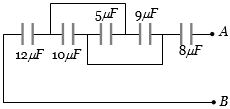
The capacities and connection of five capacitors are shown in the adjoining figure. The potential difference between the points $A$ and $B$ is $60\;volts$. Then the equivalent capacity between $A$ and $B$ and the charge on $5\,\mu F$ capacitance will be respectively
The wavelength of an $X-$ray beam is $10 \, \mathring A$. The mass of a fictitious particle having the same energy as that of the $X-$ray photons is $\frac{ x }{3} h \,kg$. The value of $x$ is ....... . $(h =$ Planck's constant $)$
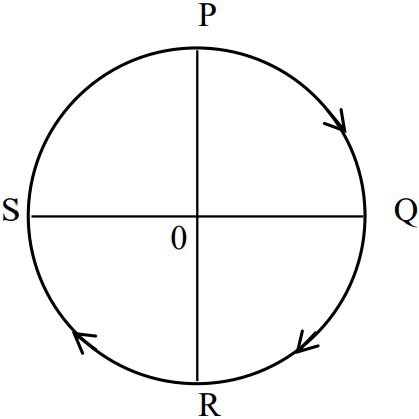
A cyclist starts from the point P of a circular 
ground of radius 2 km and travels along its circumference to the point S. The displacement of a cyclist is : 
Image
If one mole of the polyatomic gas is having two vibrational modes and $\beta$ is the ratio of molar specific heats for polyatomic gas $\left(\beta=\frac{ C _{ P }}{ C _{ v }}\right)$ then the value of $\beta$ is:
A uniform magnetic field $B$ is acting from south to north and is of magnitude $1.5$ $Wb/{m^2}$. If a proton having mass $ = 1.7 \times {10^{ - 27}}\,kg$ and charge $ = 1.6 \times {10^{ - 19}}\,C$ moves in this field vertically downwards with energy $5\, MeV$, then the force acting on it will be
A ring of mass $m$ and radius $r$ rotates about an axis passing through its centre and perpendicular to its plane with angular velocity $\omega$. Its kinetic energy is
An aeroplane is moving with a velocity $u$. It drops a packet from a height $h$. The time $t$ taken by the packet in reaching the ground will be