MCQ
In isothermal expansion, the pressure is determined by
  • A
    Temperature only
  • Compressibility only
  • C
    Both temperature and compressibility
  • D
    None of these

Answer

Correct option: B.
Compressibility only
b
(b) For such a case, pressure $ = \frac{1}{{{\rm{Compressibility}}}}$

Need a full question paper?

Generate a complete, print-ready paper with questions like this in minutes — across 16+ boards, with answer keys.
Start Generating Free

Similar questions

A rod of length $20\, cm$ is made of metal. It expands by $0.075cm$ when its temperature is raised from $0°C$ to $100°C.$ Another rod of a different metal $B$ having the same length expands by $0.045 \,cm$ for the same change in temperature. $A$ third rod of the same length is composed of two parts, one of metal $A$ and the other of metal $B$. This rod expands by $0.060\, cm$ for the same change in temperature. The portion made of metal $A$ has the length ........ $cm$
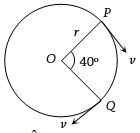
A particle is moving on a circular path of radius $r$ with uniform velocity $v$. The change in velocity when the particle moves from $P$ to $Q$ is $(\angle POQ = 40^\circ )$
The value of Planck's constant is
A closed organ pipe (closed at one end) is excited to support the third overtone. It is found that air in the pipe has
A number of holes are drilled along a diameter of a disc of radius $R$. To get minimum time period of oscillations the disc should be suspended from a horizontal axis passing through a hole whose distance from the centre should be 
The fundamental frequency of a sonometer with a weight of $4\,kg$ is $256\,Hz$ . The weight required to produce its octave is .... $kg-wt$
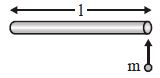
A stick of length $l$ and mass $M$ lies on a frictionless horizontal surface on which it is free to move in any way. A ball of mass $m$ moving with speed $v$ collides elastically with the stick as shown in the figure. If after the collision ball comes to rest, then what should be the mass of the ball
$5\, g$ of ice at $0°C$ is dropped in a beaker containing $20\, g$ of water at $40°C.$ The final temperature will be........ $^oC$
The energy required to take a satellite to a height $‘h’$ above Earth surface (radius of Earth $= 6.4 \times 10^3\,km$ ) is $E_1$ and kinetic energy required for the satellite to be in a circular orbit at this height is $E_2.$ The value of $h$ for which $E_1$ and $E_2$ are equal is
A sound wave of frequency $245 \,Hz$ travels with the speed of $300\, ms ^{-1}$ along the positive $x$-axis. Each point of the wave moves to and fro through a total distance of $6 \,cm$. What will be the mathematical expression of this travelling wave ?