MCQ
In Kjeldahl's method for estimation of nitrogen, $\mathrm{CuSO}_4$ acts as :
  • A
    Reducing agent
  • Catalytic agent
  • C
    Hydrolysis agent
  • D
    Oxidising agent

Answer

Correct option: B.
Catalytic agent
b
Kjeldahl's method is used for estimation of $\mathrm{N}_1$ trogen where $\mathrm{CuSO}_4$ acts as a catalyst.

Need a full question paper?

Generate a complete, print-ready paper with questions like this in minutes — across 16+ boards, with answer keys.

Start Generating Free

Similar questions

When $ 4 \,g$  of iron is burnt to ferric oxide at constant pressure, $29.28\, kJ $ of heat is evolved. What is the enthalpy of formation of ferric oxide ......$kJ$ (At. Wt. of $Fe = 56$ )
The total number of molecules with zero dipole moment among $\mathrm{CH}_4, \mathrm{BF}_3, \mathrm{H}_2 \mathrm{O}, \mathrm{HF}, \mathrm{NH}_3, \mathrm{CO}_2$ and $\mathrm{SO}_2$ is_______
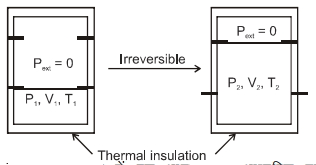
An ideal gas in a thermally insulated vessel at internal pressure $=P_1$, volume $=V_1$ and absolute temperature $= T _1$ expands irreversibly against zero external pressure, as shown in the diagram. The final internal pressure, volume and absolute temperature of the gas are $P _2, V _2$ and $T _2$, respectively. For this expansion,

$(A)$ $q=0$ $(B)$ $T_2=T_1$ $(C)$ $P_2 V_2=P_1 V_1$ $(D)$ $P_2 V_2^\gamma=P_1 V_1^\gamma$
Which of the following acid will release maximum amount of heat when completely neutralised by strong base $NaOH$ ?
Which of the following isoelectronic series would lose an electron most easily ?
Attacking or reactive or electrophilic species in nitration of benzene is or In the nitration of benzene with concentrated $HN{O_3}{\rm{ \,and \,}}{H_2}S{O_4}$ the attack on ring is made by
The number of unpaired electrons in $Z{n^{2 + }}$ is
The first four ionization energy values of an element are $191, 578, 872$ and $5962 \,k\,cal$. The number of valence electrons in the element is
Largest in size out of $Na^+ , Ne$ and $F^-$ is
$NaOH$ is a strong base. What will be $pH$ of $5.0 \times 10^{-2}\,M$ $NaOH$ solution $(log\,2 = 0.3)$