MCQ
In Kjeldahl’s method, the nitrogen present in the organic compound is quantitatively converted into
  • A
    Gaseous ammonia
  • B
    Ammonium sulphate
  • C
    Ammonium phosphate
  • Ammonia

Answer

Correct option: D.
Ammonia
d
(d) In Kjeldahl’s method, the nitrogen is estimated in the form of ammonia, which is obtained by heating compounds with $NaOH$.

$C{H_3}CON{H_2} + NaOHC \overset {\Delta} \longrightarrow {H_3}COONa + {H_2}O + N{H_3}$

Need a full question paper?

Generate a complete, print-ready paper with questions like this in minutes — across 16+ boards, with answer keys.

Start Generating Free

Similar questions

$\begin{array}{*{20}{c}}
  {A\xleftarrow{{HBr}}Ph - CH = C - C{H_3}\xrightarrow[{Peroxide}]{{HBr}}B,} \\ 
  {\,\,|} \\ 
  {\,\,\,\,\,\,\,\,C{H_3}} 
\end{array}$

$A$ and $B$ is

The pair in which both species have iron is
For the estimation of nitrogen, $1.4\, g$ of an organic compound was digested by Kjeldahl method and the evolved ammonia was absorbed in $60\, mL$ of $\frac{M}{10}$ sulphuric acid. The unreacted acid required $20\, mL$ of $\frac{M}{10}$ sodium hydroxide for complete neutralization. The percentage of nitrogen in the compound is .....$\%$
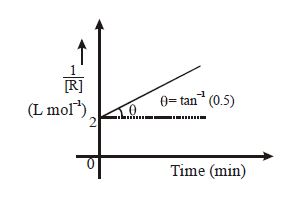
For the $2^{nd}$ order reaction ; $R \rightarrow  P$, the following graph holds true. Identify the incorrect statement
Electronegativity is a measure of the capacity of an atom to
In which reaction will an increase in the volume of the container favour the formation of products?
$\left( 1 \right)\,{N_2}\left( g \right) + 3{H_2}\left( g \right) \rightleftharpoons 2N{H_3}\left( g \right)\,,\,{K_1}$

$\left( 2 \right)\,{N_2}\left( g \right) + {O_2}\left( g \right) \rightleftharpoons 2NO\left( g \right)\,,\,{K_2}$

$\left( 3 \right)\,{H_2}\left( g \right) + \frac{1}{2}{O_2}\left( g \right) \rightleftharpoons {H_2}O\left( g \right)\,,\,{K_3}$

The equation for the equilibrium constart of the reaction

$2N{H_3}\left( g \right) + \frac{5}{2}{O_2}\left( g \right) \rightleftharpoons 2NO\left( g \right) + 3{H_2}O\left( g \right)$

$(K_4)$ in terms of $K_1 , K_2$ , and $K_3$ is

If concentration of a first order reaction is increased by $'x'$ times, then rate constant $(k)$ becomes
Among the following statement which one is true?
Which of the following aqueous solutions produce the same osmotic pressure