Question
In $\left[\begin{array}{cc}x+y & 2 \\ 5+z & x y\end{array}\right]=\left[\begin{array}{ll}6 & 2 \\ 5 & 8\end{array}\right]$ find the value of $x, y, z ?$

Answer

On comparing $x+y=6$
$5+z=5$
$x y=8 $
from equation $(1)$ and $(3)$
$x(6-x) =8$
$\Rightarrow 6 x-x^2 =8$
$\Rightarrow x^2-6 x+8 =0$
$\Rightarrow x^2-4 x-2 x+8 =0 $
$ \Rightarrow x(x-4)-2(x-4) =0$
$\Rightarrow (x-4)(x-2) =0$
$\Rightarrow x =4,2 $
$\text { when } x=4, y=6-x=6-4=2$
$\text { when } x=2, y=6-2=4$
from equation $(2), z=0$

Need a full question paper?

Generate a complete, print-ready paper with questions like this in minutes — across 16+ boards, with answer keys.
Start Generating Free

Similar questions

Differentiate the following functions with respect to x:
$3^{\text{x}\log\text{x}}$
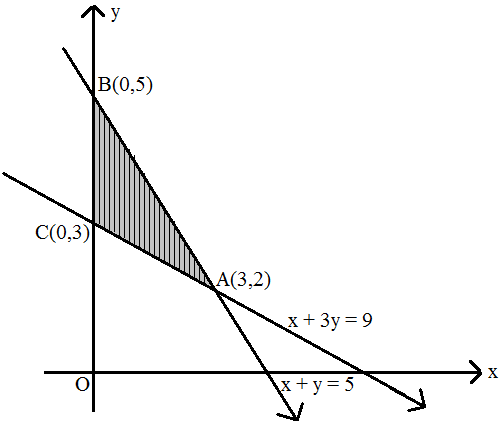
The feasible region for a LPP is shown in. Find the minimum value of Z = 11x + 7y.
Check the commutativity and associativity of the following binary operations:
'o' on Q defined by $\text{a o b}=\frac{\text{ab}}{2}$ for all a, b ∈ Q.
A dice is thrown twice and the sum of the numbers appearing is observed to be 6. What is the conditional probability that the number 4 has appeared at least once?
Find a vector $\vec{\text{r}}$ of magnitude $3\sqrt{2}$ units which makes an angle of $\frac{\pi}{4}$ and $\frac{\pi}{2}$ with and z-axes respectively.
Using differentials, find the approximate value of each of the following up to 3 places of decimal.
$(401)^{\frac{1}{2}}$
Find the value of k in this question, so that the function f is continuous at the indicated point:
$\text{f(x)}=\begin{cases}3\text{x}-8,&\text{if x}\leq5\\2\text{k},&\text{if x}>5\end{cases}$ at x = 5.
Find $|\vec{\text{a}|}$ and $\big|\vec{\text{b}}\big|$ if
$\big(\vec{\text{a}}+\vec{\text{b}}\big).\big(\vec{\text{a}}-\vec{\text{b}}\big)=12$ and $|\vec{\text{a}}|=2\big|\vec{\text{b}}\big|$
Find the vector equations of the following planes in scalar product form $(\vec{\text{r}}\cdot\vec{\text{n}}=\text{d}):$
$\vec{\text{r}}=\hat{\text{i}}-\hat{\text{j}}+\lambda(\hat{\text{i}}+\hat{\text{j}}+\hat{\text{k}})+\mu(4\hat{\text{i}}-2\hat{\text{j}}+3\hat{\text{k}})$
Evaluate the following integrals:
$\int_{1}^\limits{3}\frac{\cos(\log\text{x})}{\text{x}}\text{ dx}$