MCQ
In Melde's experiment, the string vibrates in $4$ loops when a $50 \,gram$ weight is placed in the pan of weight $15\, gram.$ To make the string to vibrates in $6$ loops the weight that has to be removed from the pan is
  • A
    $0.0007\, kg\, wt$
  • B
    $0.0021\, kg\, wt$
  • $0.036 \,kg \,wt$
  • D
    $0.0029 \,kg \,wt$

Answer

Correct option: C.
$0.036 \,kg \,wt$
c
(c) Frequency of vibration of string is given by 

$n = \frac{p}{{2l}}\sqrt {\frac{T}{m}} $==> $p\sqrt T = $constant ==> $\frac{{{p_1}}}{{{p_2}}} = \sqrt {\frac{{{T_2}}}{{{T_1}}}} $ 

Hence $\frac{4}{6} = \sqrt {\frac{{{T_2}}}{{(50 + 15)gm{\rm{ - }}force}}} $==> ${T_2} = 28.8\,gm{\rm{ - }}f$ 

Hence weight removed from the pan

$ = {T_1} - {T_2} = 65 - 28.8 = 3.62\,gm-force = 0.036 kg-f.$

Need a full question paper?

Generate a complete, print-ready paper with questions like this in minutes — across 16+ boards, with answer keys.

Start Generating Free

Similar questions

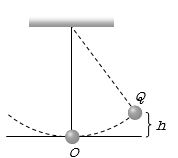
The bob of a simple pendulum is displaced from its equilibrium position $O$ to a position $Q$ which is at height h above $O$ and the bob is then released. Assuming the mass of the bob to be $m$ and time period of oscillations to be $2.0\, sec$, the tension in the string when the bob passes through $O$ is
Reason of weightlessness in a satellite is
Two projectile thrown at $30^{\circ}$ and $45^{\circ}$ with the horizontal respectively, reach the maximum height in same time. The ratio of their initial velocities is
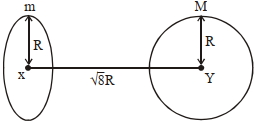
Find the gravitational force of attraction between the ring and sphere as shown in the diagram, where the plane of the ring is perpendicular to the line joining the centres. If $\sqrt{8}\, R$ is the distance between the centres of a $mng$ (of mass ' $m$ ) and a sphere (mass ' $M$ ) where both have equal radius $'R'.$
The density of water at $20^oC$ is $0.998\  gm/cm^3$ and at $40^oC$ is $0.992\ gm/cm^3$. The mean coefficient of cubical expansion (in per ${}^oC$) is
A bomb of mass $9 \,kg$ explodes into two pieces of masses $3 \,kg$ and $6 \,kg$. The velocity of mass $3 \,kg$ is $16 \,m / s$. The kinetic energy of mass $6 \,kg$ in joule is
A $20 \,g$ bullet whose specific heat is $5000 \,J kg ^{\circ} C$ and moving at $2000 \,m / s$ plunges into a $1.0 \,kg$ block of wax whose specific heat is $3000 \,J kg ^{\circ} C$. Both bullet and wax are at $25^{\circ} C$ and assume that $(i)$ the bullet comes to rest in the wax and $(ii)$ all its kinetic energy goes into heating the wax. Thermal temperature of the wax $\left(\right.$ in $\left.^{\circ} C \right)$ is close to
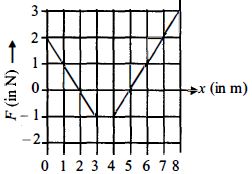
The force $\vec F\, = F\hat i$ on a particle of mass $2\, kg$, moving along the $x-$ axis is given in the figure as a function of its position $x$. The particle is moving with a velocity of $5\, m/s$ along the $x-$ axis at $x\, = 0$. What is the kinetic energy of the particle at $x\,= 8\, m$ ? .................. $\mathrm{J}$
Let V and E denote the gravitational potential and gravitational field at a point. It is possible to have:
  1. V = 0 and E = 0
  2. V = 0 and E ≠ 0
  3. V ≠ 0 and E = 0
  4. V ≠ 0 and E ≠ 0
Two cylinders $P$ and $Q$ have the same length and diameter and are made of different materials having thermal conductivities in the ratio $2 : 3$ . These two cylinders are combined to make a cylinder. One end of $P$ is kept at $100°C$  and another end of $Q$ at $0°C$ . The temperature at the interface of $P$ and $Q$ is ...... $^oC$