MCQ
In nucleic acids, the sequence is:
  • A
    Phosphate base sugar.
  • B
    Sugar phosphate base.
  • C
    Phosphate - sugar base.
  • D
    Base phosphate sugar.

Answer

  1. Phosphate - sugar base.

Explanation:

In nucleic acids, the sequence is phosphate-sugar base. Nucleic acids are polymeric macromolecules, or large biological molecules, essential for all known forms of life.

Nucleic acids, which include DNA (deoxyribonucleic acid) and RNA (ribonucleic acid), are made from monomers known as nucleotides.

Each nucleotide has three components: a 5-carbon sugar, a phosphate group and a nitrogenous base.

If the sugar is deoxyribose, the polymer is DNA. If the sugar is ribose, the polymer is RNA.

In nucleic acids , the sequence is

Need a full question paper?

Generate a complete, print-ready paper with questions like this in minutes — across 16+ boards, with answer keys.

Start Generating Free

Similar questions

The difference in the 'spin-only' magnetic moment values of $\mathrm{KMnO}_4$ and the manganese product formed during titration of $\mathrm{KMnO}_4$ against oxalic acid in acidic medium is .................... $\mathrm{BM}$. (nearest integer)
The compound with maximum value of van't Hoff factor (i) for complete dissociation of solute in aqueous solution is ;
For an endothermic reaction, $\Delta H$ represents the enthalpy of the reaction in $KJ\,mol^{-1}.$ The minimum amount of activation energy will be
The amount of ${K_2}C{r_2}{O_7}$ (eq. wt. $ 49.04$) required to prepare $100\,ml$ of its $0.05\,N$  solution is ........ $g$
$\text{E}^{\ominus}_{\text{Cell}}$ for some half cell reactions are given below. On the basis of these mark the correct answer.

  1. $\text{H}^+(\text{aq})+\text{e}^-\xrightarrow{\ \ \ \ \ \ \ \ \ \ \ \ \ }\frac{1}{2}\text{H}_2(\text{g});\ \ \ \ \ \text{E}^\ominus_{\text{Cell}}=0.00\text{V}$

  2. $2\text{H}_2\text{O}_{(\text{l})}\xrightarrow{\ \ \ \ \ \ \ \ \ \ \ \ \ \ }\text{O}_{2(\text{g})}+4\text{H}^{+}_{(\text{aq})}+4\text{e}^-;\ \ \ \ \ \text{E}^0_{\text{Cell}}=1.23\text{V}$

  3. $2\text{SO}^{2-}_{4(\text{aq})}\xrightarrow{\ \ \ \ \ \ \ \ \ \ \ \ \ }\text{S}_2\text{O}^{2-}_{8(\text{aq})}+2\text{e}^-;\ \ \ \ \ \text{E}^0_{\text{cell}}=1.96\text{V}$
    At a certain temperature, the vapour pressure of water is 50mm. The relative lowering of vapour pressure of a solution containing 36g of glucose in 900g of water is:
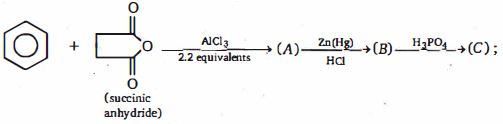
    Product $(C)$ of the above reaction is
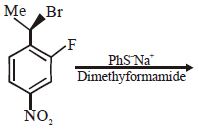
    The major product of the following reaction is
    A standard hydrogen electrode has zero electrode potential because
    Which compound is a secondary alcohol?