Question
In one average-life:

Answer

  1. More than half the active nuclei decay.
Explanation:
The average life is the mean life time for a nuclei to decay.
It is given as
$\tau=\frac{1}{\lambda}=\frac{\text{T}_{\frac{1}{2}}}{0.693}$
Here, $\tau,\lambda$ and $\text{T}_{\frac{1}{2}}$ are the average life, decay constant and half life-time of the active nuclei, respectively. The value of the average lifetime comes to be more than the average lifetime. Therefore, in one average life, more than half the active nuclei decay.

Need a full question paper?

Generate a complete, print-ready paper with questions like this in minutes — across 16+ boards, with answer keys.
Start Generating Free

Similar questions

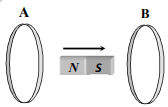
In the diagram shown if a bar magnet is moved along the common axis of two single turn coils A and B in the direction of arrow then-
Image
A parallel plate capacitor is charged to a certain voltage. Now, if the dielectric material (with dielectric constant k) is removed then the
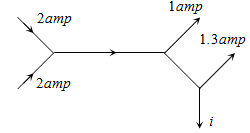
The figure below shows currents in a part of electric circuit. The current $i$ is
Two unlike charges of magnitude $q$ are separated by a distance $2 d$. The potential at a point midway between them is
The mechanism of the heat produced in a conductor when an electric current flows through it, can be explained on the basis of(a) Viscosity(b) Friction(c) Free electron theory(d) Gauss's theorem
       
A sphere of radius $R$ has a uniform distribution of electric charge in its volume. At a distance $x$ from its centre, for $x < R,$ the electric field is directly proportional to
A man wishing to get a picture of a Zebra photographed a white donkey after fitting a glass with black streaks onto the objective of his camera.
A convex lens of focal length $f$ produces an image $\frac{1}{n}$ times than that of the size of the object. The distance of the object from the lens is
Suppose, the electron in a hydrogen atom makes transition from $n = 3$ to $n = 2$ in $10^{-8}s.$ The order of the torque acting on the electron in this period, using the relation between torque and angular momentum as discussed in the chapter on rotational mechanics is:
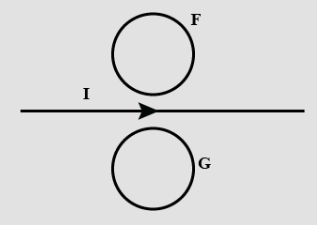
Two conducting circular loops F and G are kept in a plane on either side of a straight current-carrying wire as shown in the figure below.
If the current in the wire decreases in magnitude, the induced current in the loops will be: