In order to increase the resistance of a given wire of uniform cross section to four times its value, a fraction of its length is stretched uniformly till the full length of the wire becomes $\frac{3}{2}$ times the original length what is the value of this fraction?
Advanced


Download our appand get started for free
Experience the future of education. Simply download our apps or reach out to us for more information. Let's shape the future of learning together!No signup needed.*
Similar Questions
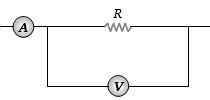
- 1The ammeter $A$ reads $2\, A$ and the voltmeter $V$ reads $20\, V$. the value of resistance $R$ is (Assuming finite resistance's of ammeter and voltmeter)View Solution
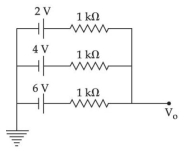
- 2In the given figure, the value of $V_{0}$ will be $.....V$.View Solution
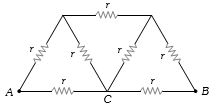
- 3In the circuit shown, the value of each resistance is $r$, then equivalent resistance of circuit between points $A$ and $B$ will beView Solution
- 4The current in the given circuit is ............ $A$View Solution
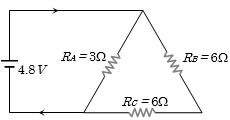
- 5Two wires of same material have length $L$ and $2L $ and cross-sectional areas $4A$ and $A$ respectively. The ratio of their specific resistance would beView Solution
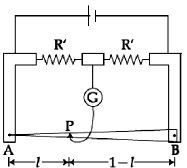
- 6In a meter bridge, the wire of length $1\, m$ has a nonuniform cross-section such that, the variation $\frac{{dR}}{{d\ell }}$ of its resistance $R$ with length $\ell $ is $\frac{{dR}}{{d\ell }} \propto \frac{1}{{\sqrt \ell }}$ Two equal resistances are connected as shown in the figure. The galvanometer has zero deflection when the jockey is at point $P$. What is the length $AP$ ? ................ $m$View Solution
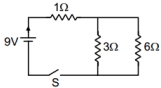
- 7After switch is closed, current drawn from the battery is (in $A$)View Solution
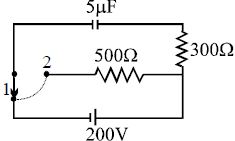
- 8A capacitor of capacitance $5\,\mu F$ is connected to a source of constant $emf$ of $200\,V$ for a long time, then the switch was shifted to contact $2$ from contact $1$ . The total amount of heat generated in the $500\,\Omega $ resistance, thereafter isView Solution
- 9View SolutionOhm's law fails in
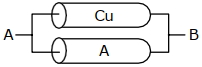
- 10A Copper $(Cu)$ rod of length $25\, {cm}$ and cross- sectional area $3\, {mm}^{2}$ is joined with a similar Aluminium $(Al)$ rod as shown in figure. Find the resistance of the combination between the ends $A$ and $B$ (in ${m} \Omega$)View Solution
(Take Resistivity of Copper $=1.7 \times 10^{-8}\, \Omega \,{m}$, Resistivity of Aluminium $=2.6 \times 10^{-8}\, \Omega \,{m}$ )