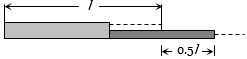
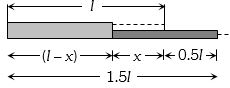
In order to quadruple the resistance of a uniform wire, a part of its length was uniformly stretched till the final length of the entire wire was $1.5$ times the original length, the part of the wire was fraction equal to
Diffcult


Download our appand get started for free
Experience the future of education. Simply download our apps or reach out to us for more information. Let's shape the future of learning together!No signup needed.*
Similar Questions
- 1A student obtained following observations in an experiment of meter bridge to find the unknown resistance of the circuit The most accurate value of unknown resistance is ............ $\Omega$View Solution
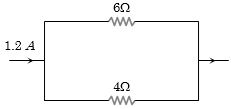
S.No. $R$ $l$ $100-l$ $S = \left( {\frac{{100 - l}}{l}} \right)R$ $1$ $20\,\Omega $ $43$ $57$ $26.51\,\Omega $ $2$ $30\,\Omega $ $51$ $49$ $28.82\,\Omega $ $3$ $40\,\Omega $ $59$ $41$ $27.80\,\Omega $ $4$ $60\,\Omega $ $70$ $30$ $25.71\,\Omega $ - 2In the figure given below, the current passing through $6\,\Omega $ resistor is ........... $ampere$View Solution
- 3A current of $2\, mA$ was passed through an unknown resistor which dissipated a power of $4.4\, W$. Dissipated power when an ideal power supply of $11\, V$ is connected across it isView Solution
- 4The $V-i$ graph for a conductor makes an angle $\theta $ with $V-$ axis. Here $ V$ denotes the voltage and $i$ denotes current. The resistance of conductor is given byView Solution
- 5In $a$ wire of cross-section radius $r$, free electrons travel with drift velocity $v$ when a current $I$ flows through the wire. What is the current in another wire of half the radius and of the same material when the drift velocity is $2v$?View Solution
- 6A cylindrical wire of radius $0.5 \,mm$ and conductivity $5 \times 10^{7}\, S / m$ is subjected to an electric field of $10 \,mV / m .$ The expected value of current in the wire will be $x ^{3} \,\pi mA$. The value of $x$ is ......View Solution
- 7Two uniform wires $A$ and $B$ are of the same metal and have equal masses. The radius of wire $A$ is twice that of wire $B$. The total resistance of A and $B$ when connected in parallel isView Solution
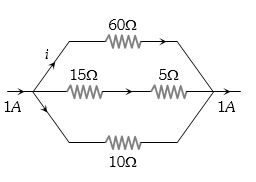
- 8The magnitude of $i$ in ampere unit isView Solution
- 9View SolutionPick out the wrong statement
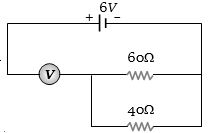
- 10The measurement of voltmeter in the following circuit is ................ $V$View Solution