MCQ
In osmosis
  • A
    Solvent molecules move from higher concentration to lower concentration
  • Solvent molecules move from lower to higher concentration
  • C
    Solute molecules move from higher to lower concentration
  • D
    Solute molecules move from lower to higher concentration

Answer

Correct option: B.
Solvent molecules move from lower to higher concentration
b
(b)In the osmosis solvent molecule move from lower concentration to higher concentration.

Need a full question paper?

Generate a complete, print-ready paper with questions like this in minutes — across 16+ boards, with answer keys.

Start Generating Free

Similar questions

The Total pressure observed by mixing two liquid $A$ and $B$ is $350\,mm\,Hg$ when their mole fractions are $0.7$ and $0.3$ respectively.The Total pressure becomes $410 \,mm\,Hg$ if the mole fractions are changed to $0.2$ and $0.8$ respectively for $A$ and $B$. The vapour pressure of pure $A$ is $...........\,mm\,Hg$. (Nearest integer)

Consider the liquids and solutions behave ideally.

$\left[\mathrm{Co}\left(\mathrm{NH}_3\right)_6\right]^{3+}$ and $\left[\mathrm{CoF}_6\right]^{3-}$ are respectively known as:
Which of the following does not uses formaldehyde in its preparation?
The half life period of a first order reaction
The major product for the following reaction is:
In which case, the order of acidic strength is not correct ?
Which one of the following statements is not true regarding $(+)$ lactose?
Acetic acid and $C{H_3}OH$ are obtained on large scale by destructive distillation of
Number of complexes from the following with even number of unpaired "$d$" electrons is  . . . . . . . . . .

${\left[\mathrm{V}\left(\mathrm{H}_2 \mathrm{O}\right)_6\right]^{3+}, \quad\left[\mathrm{Cr}\left(\mathrm{H}_2 \mathrm{O}\right)_6\right]^{2+}, \quad\left[\mathrm{Fe}\left(\mathrm{H}_2 \mathrm{O}\right)_6\right]^{3+},}$

${\left[\mathrm{Ni}\left(\mathrm{H}_2 \mathrm{O}\right)_6\right]^{3+},\left[\mathrm{Cu}\left(\mathrm{H}_2 \mathrm{O}\right)_6\right]^{2+}}$

[Given atomic numbers: $\mathrm{V}=23, \mathrm{Cr}=24, \mathrm{Fe}=26$,

$\mathrm{Ni}=28, \mathrm{Cu}=29]$

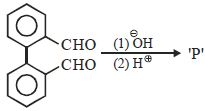
The major product $'P'$ formed in this reaction