Question
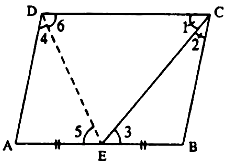
In parallelogram $ABCD, E$ is the mid$-$point of side $AB$ and $CE$  bisects angle $BCD$. Prove that $:\ (i)\  AE = AD,\ (ii)\  DE$  bisects and $∠ADC$ and $(iii)\ $ Angle $DEC$ is a right angle.
Answer


Given: parallelogram $ABCD$ in which $E$ is mid$-$point of $AB$ and $CE$ bisects $ZBCD.$
To Prove :
$(i) AE = AD$
$(ii) DE$ bisects $\angle ADC$
$(iii) \angle DEC = 90^\circ$
Const. Join $DE$
Proof : $(i) AB || CD ($Given$)$
and $CE$ bisects it.
$\angle 1 = \angle 3 ($alternate $\angle s) ……… (i)$
But $\angle 1 = \angle 2 ($Given$) …………. (ii)$
From $(i)\  (ii)$
$\angle 2 = \angle 3$
$BC = BE ($sides opp. to equal angles$)$
But $BC = AD ($opp. sides of $||gm)$
and $BE = AE ($Given$)$
$AD = AE$
$\angle 4 = \angle 5 (\angle s$ opp. to equal sides$)$
But $\angle 5 = \angle 6 ($alternate $\angle s)$
$=> \angle 4 = \angle 6$
$DE$ bisects $\angle ADC.$
Now $AD || BC$
$=> \angle D + \angle C = 180^\circ$
$2\angle 6+2\angle 1 = 180^\circ$
$DE$ and $CE$ are bisectors.
$\angle 6+\angle 1=\frac{180^{\circ}}{2}$
$ \angle 6+\angle 1=90^{\circ}$
But $\angle \mathrm{DEC}+\angle 6+\angle 1=180^{\circ}$
$\angle \mathrm{DEC}+90^{\circ}=180^{\circ}$
$\angle \mathrm{DEC}=180^{\circ}-90^{\circ}$
$\angle \mathrm{DEC}=90^{\circ}$
Hence the result.
 

Need a full question paper?

Generate a complete, print-ready paper with questions like this in minutes — across 16+ boards, with answer keys.

Start Generating Free