MCQ
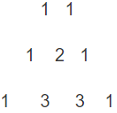
In Pascal’s triangle, each row begins with 1 and ends in
- A-1
- B$0$
- C2
- D1
Generate a complete, print-ready paper with questions like this in minutes — across 16+ boards, with answer keys.
$\lim _{t \rightarrow x} \frac{f(x) \sin t-f(t) \sin x}{t-x}=\sin ^2 x \text { for all } x \in(0, \pi)$
If $f \left(\frac{\pi}{6}\right)=-\frac{\pi}{12}$, then which of the following statement(s) is (are) TRUE?
$(A)$ $f \left(\frac{\pi}{4}\right)=\frac{\pi}{4 \sqrt{2}}$
$(B)$ $f(x)<\frac{x^4}{6}-x^2$ for all $x \in(0, \pi)$
$(C)$ There exists $\alpha \in(0, \pi)$ such that $f ^{\prime}(\alpha)=0$
$(D)$ $f ^{\prime \prime}\left(\frac{\pi}{2}\right)+ f \left(\frac{\pi}{2}\right)=0$
$\frac{x^2}{4}+\frac{y^2}{3}=1$
Let $H (\alpha, 0), 0<\alpha<2$, be a point. A straight line drawn through $H$ parallel to the $y$-axis crosses the ellipse and its auxiliary circle at points $E$ and $F$ respectively, in the first quadrant. The tangent to the ellipse at the point $E$ intersects the positive $x$-axis at a point $G$. Suppose the straight line joining $F$ and the origin makes an angle $\phi$ with the positive $x$-axis.
| $List-I$ | $List-II$ |
| If $\phi=\frac{\pi}{4}$, then the area of the triangle $F G H$ is | ($P$) $\frac{(\sqrt{3}-1)^4}{8}$ |
| If $\phi=\frac{\pi}{3}$, then the area of the triangle $F G H$ is | ($Q$) $1$ |
| If $\phi=\frac{\pi}{6}$, then the area of the triangle $F G H$ is | ($R$) $\frac{3}{4}$ |
| If $\phi=\frac{\pi}{12}$, then the area of the triangle $F G H$ is | ($S$) $\frac{1}{2 \sqrt{3}}$ |
| ($T$) $\frac{3 \sqrt{3}}{2}$ |
The correct option is:
$ (y+z) \cos 3 \theta=(x y z) \sin 3 \theta $
$ x \sin 3 \theta=\frac{2 \cos 3 \theta}{y}+\frac{2 \sin 3 \theta}{z} $
$ (x y z) \sin 3 \theta=(y+2 z) \cos 3 \theta+y \sin 3 \theta$ have a solution $\left(\mathrm{x}_0, \mathrm{y}_0, \mathrm{z}_0\right)$ with $\mathrm{y}_0 \mathrm{z}_0 \neq 0$, is