MCQ
In photoelectric effect, electrons are ejected from metals,if the incident light has a certain minimum?
  • A
    Wavelength.
  • Frequency.
  • C
    Amplitude.
  • D
    Angle of incidence.

Answer

Correct option: B.
Frequency.

Need a full question paper?

Generate a complete, print-ready paper with questions like this in minutes — across 16+ boards, with answer keys.
Start Generating Free

Similar questions

Assertion : Electrons move away from a low potential to high potential region.
Reason : Because electrons has negative charge
Among which of the following the magnetic susceptibility does not depend on the temperature?
A rocket is going towards moon with a speed $v$. The astronaut in the rocket sends signals of frequency $v$ towards the moon and receives them back on reflection from the moon. What will be the frequency of the signal received by the astronaut (Take $v << c$ )
The de-Broglie wavelength associated with the electron in the $n\, = 4$ level is
The current flowing through a coil of resistance $900\, ohms $ is to be reduced by $90\,\%$. What value of shunt should be connected across the coil ............. $\Omega $
The maximum power drawn out of the cell from a source is given by (where r is internal resistance)
Three bulbs of 40W, 60W and 100W are arranged in series with 220V. Which bulb has minimum resistance
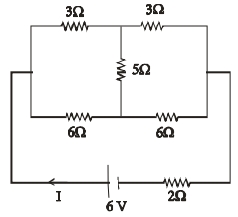
A battery of $6\,V$ is connected to the circuit as shown below. The current I drawn from the battery is:
For Young's double slit experiment, two statements are given below :

Statement $I:$ If screen is moved away from the plane of slits, angular separation of the fringes remains constant.

Statement $II:$ If the monochromatic source is replaced by another monochromatic source of larger wavelength, the angular separation of fringes decreases.

In the light of the above statements, choose the correct answer from the options given below :

An electromagnetic wave going through vacuum is described by $\text{E}=\text{E}_0\sin(\text{kx}-\omega\text{t}),\text{ B}=\text{B}_0\sin(\text{kx}-\omega\text{t})$ Then: