MCQ
In photoelectric effect, stopping potential depends on
  • A
    frequency of the incident light
  • B
    intensity of the incident light by varies source distance
  • C
    emitter’s properties
  • $(A)$ and $(C)$ both

Answer

Correct option: D.
$(A)$ and $(C)$ both
d

Need a full question paper?

Generate a complete, print-ready paper with questions like this in minutes — across 16+ boards, with answer keys.

Start Generating Free

Similar questions

If two light waves having same frequency have intensity ratio 4 : 1 and they interfere, the ratio of maximum to minimum intensity in the pattern will be
Asteroids are
A short electric dipole has a dipole moment of $16 \times 10^{-9}\, Cm .$ The electric potential due to the dipole at a point at a distance of $0.6\, m$ from the centre of the dipole, situated on a line making an angle of $60^{\circ}$ with the dipole axis is $.........V$

$\left(\frac{1}{4 \pi \in_{0}}=9 \times 10^{9} Nm ^{2} / C ^{2}\right)$
Light from the constellation Virgo is observed to increase in wavelength by $0.4$. With respect to Earth the constellation is
For a charged spherical ball, electrostatic potential inside the ball varies with $r$ as $V =2 ar ^2+ b$. Here, $a$ and $b$ are constant and $r$ is the distance from the center. The volume charge density inside the ball is $-\lambda a \varepsilon$. The value of $\lambda$ is $...........$. $\varepsilon=$ permittivity of medium.
In an $n-$type semiconductor, donor valence band is:
At the time of total solar eclipse, the spectrum of solar radiation would be
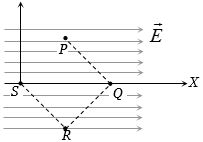
Point charge $q$ moves from point $P$ to point $S$ along the path $PQRS$ (figure shown) in a uniform electric field $E$ pointing coparallel to the positive direction of the $X - $axis. The coordinates of the points $P,\,Q,\,R$ and $S$ are $(a,\,b,\,0),\;(2a,\,0,\,0),\;(a,\, - b,\,0)$ and $(0,\,0,\,0)$ respectively. The work done by the field in the above process is given by the expression
A beam of light of $\lambda = 600 \,\,nm$ from a distant source falls on a single slit $1\,\, mm$ wide and the resulting diffraction pattern is observed on a screen $2\,\, m$ away. The distance between first dark fringes on either side of the central bright fringe is 
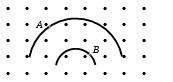
Two particles $A$ and $B$ of masses ${m_A}$ and ${m_B}$ respectively and having the same charge are moving in a plane. A uniform magnetic field exists perpendicular to this plane. The speeds of the particles are ${v_A}$ and ${v_B}$ respectively, and the trajectories are as shown in the figure. Then