MCQ
In PN-junction diode the reverse saturation current is $10^{-5} amp$ at $27^{\circ} C$ The forward current for a voltage of 0.2 volt is $\left[\exp (7.62)=2038.6, K=1.4 \times 10^{-23} J / K \right]$
  • A
    $2037.6 \times 10^{-3} amp$
  • B
    $203.76 \times 10^{-3} amp$
  • $20.376 \times 10^{-3} amp$
  • D
    $2.0376 \times 10^3 amp$

Answer

Correct option: C.
$20.376 \times 10^{-3} amp$
(c) $20.376 \times 10^{-3} amp$

Need a full question paper?

Generate a complete, print-ready paper with questions like this in minutes — across 16+ boards, with answer keys.

Start Generating Free

Similar questions

An alternating voltage$\text{V}=200\sqrt{2}\sin100\text{t},$ Where $V$ is in volt and t is in seconds, is connected to a series combination of $1\mu\text{F}$ capacitor and $10\text{k}\Omega$ resistor through an $AC$ ammeter. The reading of the ammeter will be $.....$
If the sizes of charged bodies are very small as compared to the distance between them then the charged bodies are called as:
If a metal cube of side $5\, cm$ has a charge of $6$ microcoulombs, then the surface charge density is
A series $R-C$ combination is connected to an $AC$ voltage of angular frequency $\omega=500 \ radian / s$. If the impedance of the $R-C$ circuit is $R \sqrt{1.25}$, the time constant (in millisecond) of the circuit is
Ten capacitor are joined in parallel and charged with a battery up to a potential V. They are then disconnected from battery and joined again in series then the potential of this combination will be
When a slab of dielectric material is introduced between the parallel plates of a capacitor which remains connected to a battery, then charge on plates relative to earlier charge
The two ends of a uniform conductor are joined to a cell of $e.m.f.$ $E$ and some internal resistance. Starting from the midpoint $P$ of the conductor, we move in the direction of current and return to $P$. The potential $V$ at every point on the path is plotted against the distance covered $(x)$. Which of the following graphs best represents the resulting curve
Two small spheres each carrying a charge q are placed r metre apart. If one of the spheres is taken around the other one in a circular path of radius r, the work done will be equal to
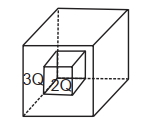
$\mathrm{C}_1$ and $\mathrm{C}_2$ are two hollow concentric cubes enclosing charges $2 Q$ and $3 Q$ respectively as shown in figure. The ratio of electric flux passing through $\mathrm{C}_1$ and $\mathrm{C}_2$ is :
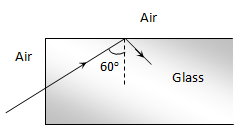
A light ray from air is incident (as shown in figure) at one end of a glass fiber (refractive index m = 1.5) making an incidence angle of $60^{\circ}$ on the lateral surface, so that it undergoes a total internal reflection. How much time would it take to traverse the straight fiber of length 1 km