In potentiometer a balance point is obtained, when
Easy
Download our app for free and get started
(b) In general, if the arrangement is not balanced, there will be a potential difference across the galvanometer, $G.$ This will only be zero means balance when the $p.d.$ of the wire between the $+ve$ end of battery to jockey becomes equal to the $e.m.f.$ of the experimental cell.

Download our appand get started for free
Experience the future of education. Simply download our apps or reach out to us for more information. Let's shape the future of learning together!No signup needed.*
Similar Questions
- 1Net resistance between $X$ and $Y$ isView Solution
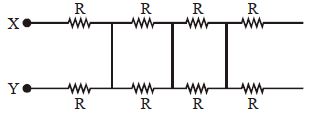
- 2Two identical batteries, each of $e.m.f.$ $2\, volt$ and internal resistance $1.0\, ohm$ are available to produce heat in an external resistance $R = 0.5\,ohm$ by passing a current through it. The maximum Joulean power that can be developed across $R$ using these batteries is ............. $watt$View Solution
- 3The supply voltage to room is $120\ V$. The resistance of the lead wires is $6\,\Omega$ . A $60\ W$ bulb is already switched on. What is the decrease of voltage across the bulb, when a $240\ W$ heater is switched on in parallel to the bulb? ............. $V$View Solution
- 4How many $60 \,W$ bulbs may be safely run on $220 \,V$ using a $5 \,A$ fuse is .........View Solution
- 5Four ammeters with identical internal resistances $r$ and a resistor of resistance $R$ are connected to a current source as shown in figure. It is known that the reading of the ammeter $A_1$ is $I_1 = 3\ A$ and the reading of the ammeter $A_2$ is $I_2 = 5\ A$ . Determine the ratio of the resistances $R/r$ .View Solution
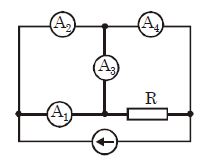
- 6$100$ cells each of $e.m.f.$ $5\, V$ and internal resistance $1\, ohm$ are to be arranged so as to produce maximum current in a $25\, ohms$ resistance. Each row is to contain equal number of cells. The number of rows should beView Solution
- 7A $220 \; V , 50 \; Hz$ AC source is connected to a $25 \; V$, $5 \; W$ lamp and an additional resistance $R$ in series (as shown in figure) to run the lamp at its peak brightness, then the value of $R$ (in ohm) will beView Solution
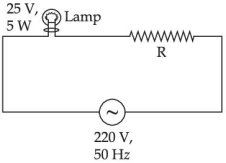
- 8For the circuits shown in figures $I$ and $II$, the voltmeter reading would beView Solution
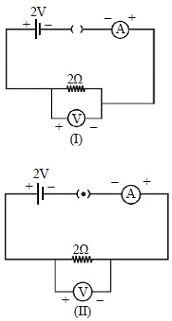
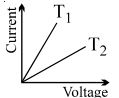
- 9The current in a metallic conductor is plotted against voltage at two different temperatures $T_1$ and $T_2$. Which is correctView Solution
- 10View SolutionOhm's law is true