MCQ
In refraction, light waves are bent on passing from one medium to the second medium, because, in the second medium
  • A
    the frequency is different
  • B
    the coefficient of elasticity is different
  • the speed is different
  • D
    the amplitude is smaller

Answer

Correct option: C.
the speed is different
c
Since the speed of light changes in the second medium, its direction also changes.

Need a full question paper?

Generate a complete, print-ready paper with questions like this in minutes — across 16+ boards, with answer keys.
Start Generating Free

Similar questions

When light wave suffers reflection at the interface from air to glass, the change in phase of the reflected wave is equal to
A transmitter supplies $9 \,kW$ to the aerial when unmodulated. The power radiated when modulated to $40\%$ is........$kW$
The transition from the state $n = 4$ to $n = 3$ in a hydrogen like atom results in ultraviolet radiation. Infrared radiation will be obtained in the transition from:
One proton beam enters a magnetic field of ${10^{ - 4}}$ $T$ normally, Specific charge = ${10^{11}}\,C/kg.$ velocity = ${10^7}\,m/s$. What is the radius of the circle described by it....$m$
Select the correct statement about electric charge
64 drops each having the capacity C and potential V are combined to form a big drop. If the charge on the small drop is q, then the charge on the big drop will be
An electron moves with speed $2 \times {10^5}\,m/s$ along the positive $x$-direction in the presence of a magnetic induction $B = \hat i + 4\hat j - 3\hat k$ (in $Tesla$) The magnitude of the force experienced by the electron in Newton's is (charge on the electron =$1.6 \times {10^{ - 19}}C)$
A coil of $200$ turns and area $0.20 \mathrm{~m}^2$ is rotated at half a revolution per second and is placed in uniform magnetic field of $0.01 \mathrm{~T}$ perpendicular to axis of rotation of the coil. The maximum voltage generated in the coil is $\frac{2 \pi}{\beta}$ volt. The value of $\beta$ is______________
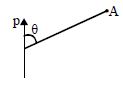
The electric field at $A$ due to dipole $p$ is perpendicular to $p.$ The angle $ \theta $ is :-
In an $ac$ circuit, the potential difference across an inductance and resistance joined in series are respectively $16\, V$ and $20 \,V$. The total potential difference across the circuit is.......$V$