MCQ
In series combination of resistances:
- Ap.d. is same across each resistance.
- Btotal resistance is reduced.
- Ccurrent is same in each resistance.
- Dall above are true.
Explanation:
Components connected in series are connected along a single path, so the same current flows through all of the components. The current through each of the components is the same, and the voltage across the circuit is the sum of the voltages across each component. In a series circuit, every device must function for the circuit to be complete. One bulb burning out in a series circuit breaks the circuit. A circuit composed solely of components connected in series is known as a series circuit.
The total resistance of resistors in series is equal to the sum of their individual resistances. Hence, the Equivalent resistance is more than the individual resistances because a sum is taken of all the individual resistances. That is, Rtotal = R1 + R2. The current is given as I = I1 = I2.
Below is the diagrammatic representation of 2 resistors R1 and R2 connected in series.
Generate a complete, print-ready paper with questions like this in minutes — across 16+ boards, with answer keys.
Two magnets of same size and mass make respectively 10 and 15 oscillations per minute at certain place. The ratio of their magnetic moments is
| (a) 4 : 9 | (b) 9 : 4 | (c) 2 : 3 | (d) 3 : 2 |
Force between two unit pole strength placed at a distance of one metre is
| (a) 1 N |
(b) 
|
(c) 
|
(d) 4π 
|
In the circuit as shown in the figure the effective capacitance between A and B is
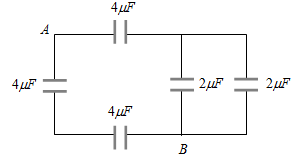
|
(a) 3 μF |
(b) 2 μF |
(c) 4 μF |
(d) 8 μF |
A coil has an inductance of 2.5 H and a resistance of 0.5 r. If the coil is suddenly connected across a 6.0 volt battery, then the time required for the current to rise 0.63 of its final value is
|
(a) 3.5 sec |
(b) 4.0 sec |
(c) 4.5 sec |
(d) 5.0 sec |
Activity of radioactive element decreased to one third of original activity  in 9 years. After further 9 years, its activity will be
|
(a)
|
(b) 
|
(c) |
(d) |
