MCQ
In simple harmonic motion, the force:
  • A
    Is constant in magnitude only.
  • B
    Is constant in direction only.
  • Varies in magnitude as well as in direction.
  • D
    Is constant in both magnitude and direction.

Answer

Correct option: C.
Varies in magnitude as well as in direction.
In $\text{SHM,}$ force varies in magnitude as well as in direction. As, for the particle executing $\text{SHM,}$ the force subjected to it is always proportional to the displacement of the particle and is directed towards the mean position.

Need a full question paper?

Generate a complete, print-ready paper with questions like this in minutes — across 16+ boards, with answer keys.

Start Generating Free

Similar questions

If a force $10 \widehat i +15 \widehat j + 25 \widehat k$ acts on a system and gives an  acceleration $2 \widehat i + 3 \widehat j - 5 \widehat k$ to the centre of mass of the  system, the mass of the system is
A ball dropped from the top of tower falls first half height of tower in $10 \,s$. The total time spend by ball in air is ......... $s$ [Take $g=10 \,m / s ^2$ ]
A satellite of mass m is at a distance of $'a'$ from a star of mass $M.$ The speed of the satellite is $u.$ Suppose the law of universal gravity is $F=-G\frac{Mm}{r^{2.1}}$ instead of $F=-G\frac{Mm}{r^{2}}$ find the speed of the satellite when it is at $a$ distance $b$ from the star.
The vapour of a substance behaves as a gas
The Young's modulus of a wire of length $L$ and radius $r$ is $Y$. If the length is reduced to $\frac{L}{2}$ and radius is $\frac{r}{2}$ , then the Young's modulus will be
A small steel sphere of mass $m$ is falling vertically through a viscous liquid with a constant speed $v$ . Which row in the table correctly describes the changes with time in the kinetic energy and gravitational potential energy of the sphere?

Kinetic Energy || Gravitational Potential Energy
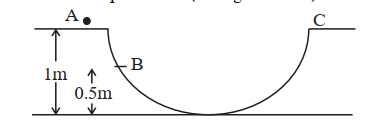
 

A particle is placed at the point $\mathrm{A}$ of a frictionless track $A B C$ as shown in figure. It is gently pushed toward right. The speed of the particle when it reaches the point $B$ is: $\left(\right.$ Take $g=10 \mathrm{~m} / \mathrm{s}^2$ ).
Acork of density $0.5\ gcm^{-3}$ floats on a calm swimming pool. The fraction of the cork’s volume which is under water is ........ $\%$
The average degree of freedom per molecule of a gas is $6$. The gas performs $25\  J$ work, while expanding at constant pressure. The heat absorbed by the gas is   .... $J$
A solid metallic sphere of radius $r$ is allowed to fall freely through air. If the frictional resistance due to air is proportional to the cross-sectional area and to the square of the velocity, then the terminal velocity of the sphere is proportional to which of the following?