MCQ
In solid argon, the atoms are held together by
  • A
    Ionic bonds
  • B
    Hydrogen bonds
  • Vander Waals forces
  • D
    Hydrophobic forces

Answer

Correct option: C.
Vander Waals forces
(c)The melting and boiling points of argon is low hence, in solid argon atoms are held together by weak Vander Waal’s forces.

Need a full question paper?

Generate a complete, print-ready paper with questions like this in minutes — across 16+ boards, with answer keys.

Start Generating Free

Similar questions

Which of the following compounds will show the maximum ‘enol’ content?
The number of oxygen atoms in $4.4\ gm$ of $CO_2$ is approx.
In a period from $Li$ to $F$, ionization potential
Number of compounds/species from the following with non-zero dipole moment is. . . . . .  $\mathrm{BeCl}_2, \mathrm{BCl}_3, \mathrm{NF}_3, \mathrm{XeF}_4, \mathrm{CCl}_4, \mathrm{H}_2 \mathrm{O} \mathrm{H}_2 \mathrm{~S}, \mathrm{HBr}$, $\mathrm{CO}_2, \mathrm{H}_2, \mathrm{HCl}$
Which of the following order is/are correct

$(1) Li < Be < B < C (IE_1)$

$(2) Li < Na < K < Rb < Cs$ (Reducing power in gaseous state)

$(3) Li^+ < Na^+ < K^+ < Rb^+ < Cs^+$ (Ionic mobility in aqueous solution)

$(4) S > Se > Te > O [EA]$

Supposing the electron is present in the $4^{th}$ energy level of $H-$ atom. When the electron returns to ground state the possible transitions would be :
Consider the following reactions:

$(i)$  $H_{(aq)}^+ + OH^-= H_2O_{(l)} ,$   $\Delta H = -X_1\,kJ \,mol^{-1}$

$(ii)$  $H_{2(g)} + \frac{1}{2}O_{2(g)} = H_2O_{(l)},$   $\Delta H = -X_2\,kJ \,mol^{-1}$

$(iii)$  $CO_{2(g)} + H_{2(g)} = CO_{(g)} + H_2O_{(l)},$   $\Delta H = -X_3\, kJ\, mol^{-1}$

$(iv)$  $ C_2H_{2(g)}+  \frac{5}{2} O_{2(g)} = 2CO_{2(g)} + H_2O_{(l)},$   $\Delta H = -X_4\,kJ \,mol^{-1}$

Enthalpy of formation of $H_2O_{(l)}$ is
$0.24 \,g$ of an organic compound gave $0.22\, g$ $C{O_2}$ on complete combustion. If it contains $1.66\%$ hydrogen, then the percentage of $C$ and $O$ will be
The $IUPAC$ name of $\begin{matrix}
   C{{H}_{2}}-CN  \\
   |\,\,\,\,\,\,\,\,\,\,\,\,\,\,\,\,\,\,\,\,\,\,\,\,  \\
   C{{H}_{2}}-CN  \\
\end{matrix}$ is
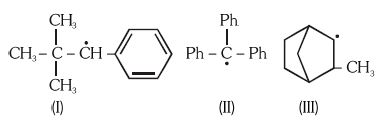
Consider the following compounds Hyperconjugation occurs $In$