MCQ
In stationary waves, distance between a node and its nearest antinode is $20 cm$. The phase difference between two particles having a separation of $60 cm$ will be
  • A
    Zero
  • B
    $\pi /2$
  • C
    $\pi$
  • $3 \pi /2$

Answer

Correct option: D.
$3 \pi /2$
d
(d) $\frac{\lambda }{4} = 20 \Rightarrow \lambda = \,80\,cm$,

also $\Delta \phi = \frac{\lambda }{{2\pi }}.\,\Delta x$ 

==> $\Delta \phi = $ $\frac{{60}}{{80}} \times 2\pi = \frac{{3\pi }}{2}$

Need a full question paper?

Generate a complete, print-ready paper with questions like this in minutes — across 16+ boards, with answer keys.
Start Generating Free

Similar questions

Hydrogen atom does not emit $X-$ rays because
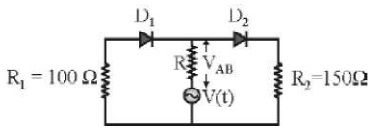
In the circuit given below, $V ( t )$ is the sinusoidal voltage source, voltage drop $V_{A B}(t)$ across the resistance $R$ is
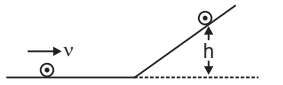
A disc of radius $R$ and mass $M$ is rolling horizontally without slipping with speed $v$. It then moves up an inclined smooth surface as shown in figure. The maximum height that the disc can go up the incline is:
A metallic block of density $5\,gm \,cm^{-3}$ and having dimensions $5 cm × 5 cm × 5 cm$ is weighed in water. Its apparent weight will be
A group of people watch a ice show which is held in closed area . Skaters perform a . music show whose level is $60\ db$ . Spectator can yell at $40.0 \ dB$ . Which one of the them represent approx combine sound level
Two sinusoidal waves given below are superposed

$y_1=A \sin \left(k x-\omega t+\frac{\pi}{6}\right), \quad y_2=A \sin \left(k x-\omega t-\frac{\pi}{6}\right)$

The equation of resultant wave is
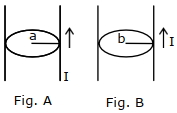
Figure $A$ and $B$ shown two long straight wires of circular cross-section ($a$ and $b$ with $a$ $<$ $b$), carrying current $I$ which is uniformly distributed across the cross-section. The magnitude of magnetic field $B$ varies with radius $r$ and can be represented as
The instantaneous values of current and voltage in an ac circuit are $i = 100\sin 314\,t\,amp$ and $e = 200\sin \,(314\,t + \pi /3)V$ respectively. If the resistance is $1 \Omega$ then the reactance of the circuit will be
A source $S_1$ is producing, $10^{15}$ photons per second of wavelength $5000 \;\mathring A.$ Another source $S_2$ is producing $1.02 \times 10^{15}$ photons per second of wavelength $5100\;\mathring A$. Then, $($ power of $S_2)/$  $($ power of $S_1)$ is equal to
The source producing sound and an observer both are moving along the direction of propagation of sound waves. If the respective velocities of sound, source and an observer are $v,  {v_s}$ and ${v_o}$, then the apparent frequency heard by the observer will be ($n =$ frequency of sound)