In steel, the Young's modulus and the strain at the breaking point are $2 \times {10^{11}}\,N{m^{ - 2}}$ and $0.15$ respectively. The stress at the breaking point for steel is therefore
Easy
Download our app for free and get started
(d) Breaking stress $=$ strain $\times$ Young's modulus
$ = 0.15 \times 2{ \times ^{11}} = 3 \times {10^{10}}\;N{m^{ - 2}}$

Download our appand get started for free
Experience the future of education. Simply download our apps or reach out to us for more information. Let's shape the future of learning together!No signup needed.*
Similar Questions
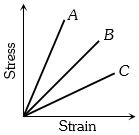
- 1The stress-strain curves for brass, steel and rubber are shown in the figure. The lines $A, B$ and $C$ are forView Solution
- 2The Poisson's ratio of a material is $0.5$. If a force is applied to a wire of this material, there is a decrease in the cross-sectional area by $4 \%$. The percentage increase in the length is ........ $\%$View Solution
- 3Calculate the work done, if a wire is loaded by $'Mg'$ weight and the increase in length is $'l'$View Solution
- 4Young's modules of material of a wire of length ' $L$ ' and cross-sectional area $A$ is $Y$. If the length of the wire is doubled and cross-sectional area is halved then Young's $modules$ will be :View Solution
- 5A fixed volume of iron is drawn into a wire of length $L.$ The extension $x$ produced in this wire by a constant force $F$ is proportional toView Solution
- 6Under the same load, wire $A$ having length $5.0\,m$ and cross section $2.5 \times 10^{-5}\,m ^2$ stretches uniformly by the same amount as another wire $B$ of length $6.0\,m$ and a cross section of $3.0 \times 10^{-5}\,m ^2$ stretches. The ratio of the Young's modulus of wire $A$ to that of wire $B$ will beView Solution
- 7$K$ is the force constant of a spring. The work done in increasing its extension from ${l_1}$ to ${l_2}$ will beView Solution
- 8The work done in increasing the length of a $1$ $metre$ long wire of cross-section area $1\, mm^2$ through $1\, mm$ will be ....... $J$ $(Y = 2\times10^{11}\, Nm^{-2})$View Solution
- 9A steel wire of diameter $2 \,mm$ has a breaking strength of $4 \times 10^5 \,N.$ the breaking force $......... \times 10^5 \,N$ of similar steel wire of diameter $1.5 \,mm$ ?View Solution
- 10The density and breaking stress of a wire are $6 \times$ $10^4 \mathrm{~kg} / \mathrm{m}^3$ and $1.2 \times 10^8 \mathrm{~N} / \mathrm{m}^2$ respectively. The wire is suspended from a rigid support on a planet where acceleration due to gravity is $\frac{1^{\text {rd }}}{3}$ of the value on the surface of earth. The maximum length of the wire with breaking is ............ $\mathrm{m}$ (take, $\mathrm{g}=$ $\left.10 \mathrm{~m} / \mathrm{s}^2\right)$View Solution