MCQ
In the above chemical reaction sequence " $\mathrm{A}$ " and " $\mathrm{B}$ " respectively are :
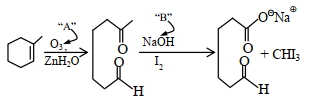
  • $\mathrm{O}_3, \mathrm{Zn} / \mathrm{H}_2 \mathrm{O}$ and $\mathrm{NaOH}_{\text {(alc.). }} / \mathrm{I}_2$
  • B
    $\mathrm{H}_2 \mathrm{O}, \mathrm{H}^{+}$and $\mathrm{NaOH}_{\text {(alc.) }} / \mathrm{I}_2$
  • C
    $\mathrm{H}_2 \mathrm{O}, \mathrm{H}^{+}$and $\mathrm{KMnO}_4$
  • D
    $\mathrm{O}_3, \mathrm{Zn} / \mathrm{H}_2 \mathrm{O}$ and $\mathrm{KMnO}_4$

Answer

Correct option: A.
$\mathrm{O}_3, \mathrm{Zn} / \mathrm{H}_2 \mathrm{O}$ and $\mathrm{NaOH}_{\text {(alc.). }} / \mathrm{I}_2$
a

Need a full question paper?

Generate a complete, print-ready paper with questions like this in minutes — across 16+ boards, with answer keys.

Start Generating Free

Similar questions

Mark the element which shows only one oxidation state
$\begin{array}{*{20}{c}}
  {O\,\,\,\,\,\,\,\,\,\,\,\,\,\,\,\,\,\,\,\,\,\,\,\,\,\,\,\,\,\,\,\,\,\,\,\,\,\,} \\ 
  {||\,\,\,\,\,\,\,\,\,\,\,\,\,\,\,\,\,\,\,\,\,\,\,\,\,\,\,\,\,\,\,\,\,\,\,\,\,\,\,} \\ 
  {R - C - OR \to RC{H_2}OH} 
\end{array}$
Which of the following expressions correctly represents the equivalent conductance at are the equivalent conductances infinite dilution of $Al_2(SO_4)_3 .$ Given that $\mathop {{\Lambda _{A{l^{3 + }}}}}\limits^{o\,\,\,\,\,\,\,\,\,\,\,\,\,} $ and $\mathop {{\Lambda _{SO_4^{2 - }}}}\limits^{o\,\,\,\,\,\,\,\,\,\,\,} $ are the equivalent conductances at infinite dilution of the respective ions?
Steel differs from pig iron and wrought iron in that it contains
A flask is filled with equal moles of $A$ and $B$. The half lives of $A$ and $B$ are $100\, s$ and $50 \,s$ respectively and are independent of the initial concentration. The time required for the concentration of $A$ to be four times that of $B$ is $....\,s.$

(Given : $\ln 2=0.693$ )

Which complex compound is most stable?
Which of the following reaction would be incorrect ?
Osmotic pressure of  $0.1\,M $ solution of $NaCl$ and $N{a_2}S{O_4}$ will be
Consider the sulphides $\mathrm{HgS}, \mathrm{PbS}, \mathrm{CuS}, \mathrm{Sb}_{2} \mathrm{~S}_{3}$, $\mathrm{As}_{2} \mathrm{~S}_{3}$ and $\mathrm{CdS}$. Number of these sulphides soluble in $50\, \% \,\mathrm{HNO}_{3}$ is .... .
For reaction $A \to B$, the rate constant $k_1 = A_1    e^{-Ea_{1} /(RT)}$ and for the reaction $X \to Y$ the rate constant $k_2 = A_2 e^{-Ea_2 /(RT)}$ . If $A_1 = 10^{8}, \,\,A_2 = 10^{10}$ and $E_{a_1} = 600\ cal/mol$, $E_{a_2} = 1800\, cal/mol$, then the temperature at which $k_1 = k_2$ is (Given : $R = 2 \,cal/K-mol$)