MCQ
In the above figure $D$ and $E$ respectively represent
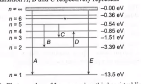
  • Absorption line of Balmer series and the ionization potential of hydrogen
  • B
    Absorption line of Balmer series and the wavelength lesser than lowest of the Lyman series
  • C
    Spectral line of Balmer series and the maximum wavelength of Lyman series
  • D
    Spectral line of Lyman series and the absorption of greater wavelength of limiting value of Paschen series

Answer

Correct option: A.
Absorption line of Balmer series and the ionization potential of hydrogen
a
(a) $D$ is excitation of electron from $2nd$ orbit corresponding to absorption line in Balmer series and $E$ is the energy released to bring the electron from $\infty $ to ground state i.e. ionisation potential.

Need a full question paper?

Generate a complete, print-ready paper with questions like this in minutes — across 16+ boards, with answer keys.

Start Generating Free

Similar questions

An electron with speed $v$ and a photon with speed $c$ have the same $de-Broglie$ wavelength. If the kinetic energy and momentum of electron are $E_{ e }$ and $pe _{ e }$ and that of photon are $E _{ ph }$ and $p _{ ph }$ respectively. Which of the following is correct?
Two satellites $A$ and $B$ of masses $200\, kg$ and $400\, kg$ are revolving round the earth at height of $600\, km$ and $1600\, km$ respectively. If $T _{ A }$ and $T _{ B }$ are the time periods of $A$ and $B$ respectively then the value of $T _{ B }- T _{ A }$

[Given : radius of earth $=6400\, km$, mass of earth $=6 \times 10^{24}\, kg$ ]

Match List $I$ with List $II$

LIST$-I$ LIST$-II$
$(A)$  Torque $(I)$    $ML ^{-2} T ^{-2}$
$(B)$   Stress $(II)$   $ML ^2 T ^{-2}$
$(C)$   Pressure of gradient $(III)$   $ML ^{-1} T ^{-1}$
$(D)$   Coefficient of viscosity $(IV)$   $ML ^{-1} T ^{-2}$

Choose the correct answer from the options given below

Surface of the lake is at $2^{\circ} C$. The temperature of the bottom of the lake is ....... $^{\circ} C$
When $UV$ light of wavelength $300 \ nm$ is incident on the metal surface having work function $2.13 eV,$ electron emission takes place. The stopping potential is : $($Given $hc = 1240 eV nm)$
A thin rod of length $L$ is bent to form a semicircle. The mass of rod is $M$. What will be the gravitational potential at the centre of the circle?
A circular coil of $1000 \,\,turns$ each with area $1\, m ^{2}$ is rotated about its vertical diameter at the rate of one revolution per second in a uniform horizontal magnetic field of $0.07 \,T$. The maximum voltage generation will be......... $V$.
A ball falling in a lake of depth $200\, m$ shows $0.1\%$ decrease in its volume at the bottom. What is the bulk modulus of the material of the ball
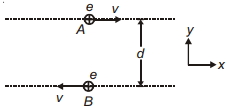
Two protons $A$ and $B$ move parallel to the $x$-axis in opposite directions with equal speeds $v$. At the instant shown, the ratio of magnetic force and electric force acting on the proton $A$ is ( $c=$ speed of light in vacuum)
A coil of wire having finite inductance and resistance has a conducting ring placed coaxially within it. The coil is connected to a battery at time $t = 0$, so that a time-dependent current ${I_1}(t)$ starts flowing through the coil. If ${I_2}(t)$ is the current induced in the ring. and $B(t)$ is the magnetic field at the axis of the coil due to ${I_1}(t),$ then as a function of time $(t > 0)$, the product $I_2$ $(t) \,B(t)$