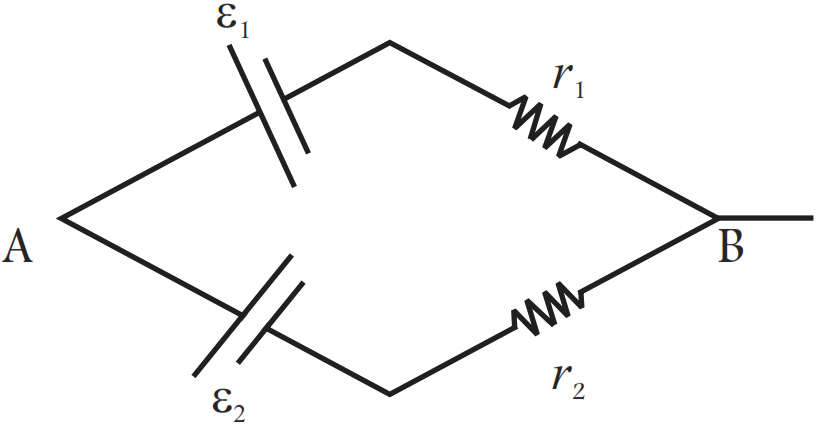
Question
In the above question, potential difference across the 40Ω resistance will be(a) Zero(b) 80 V(c) 40 V(d) 120 V
       

Answer

(a) Zero

Need a full question paper?

Generate a complete, print-ready paper with questions like this in minutes — across 16+ boards, with answer keys.
Start Generating Free

Similar questions

Four plates of equal area $A$ are separated by equal distances $d$ and are arranged as shown in the figure. The equivalent capacity is
In an a.c. generator the speed at which the coil rotates is doubled. How would this affect the frequency of output voltage?
Two ends of a conducting rod of varying cross-section are maintained at $200^∘C$ and $0^∘C$ respectively, figure. In steady state.image
There are seven orbitals in a subshell then the value of l for it will be:
A radioactive element ${90^X}^{238}$ decay into ${83^X}^{222}$. The number of $\beta -$ particles emitted are
Assertion   :   A metallic shield in form of a hollow shell may be built to block an electric field.
Reason       : In a hollow spherical shield, the electric field inside it is zero at every point. (a) If both assertion and reason are true and the reason is the correct explanation of the assertion.(b) If both assertion and reason are true but reason is not the correct explanation of the assertion.(c) If assertion is true but reason is false.(d) If the assertion and reason both are false.


Which is the factor that internal resistance does not depend on?
what is the potential difference between two points, if 2J of work must be done to move a 4 mC charge from one point to another is:
Two batteries of emf $\epsilon_1$ and $\epsilon_2(\epsilon_2>\epsilon_1)$ and internal resistances $r_1$ and $r_2$ respectively are connected in parallel as shown in Fig.
A capacitor with no dielectric is connected to a battery at t = 0. Consider a point A in the connecting wires and a point B in between the plates.
  1. There is no current through A.
  2. There is no current through B.
  3. There is a current through A as long as the charging is not complete.
  4. There is a current through B as long as the charging is not complete.