MCQ
In the above reaction $o/p$ ratio will be highest when
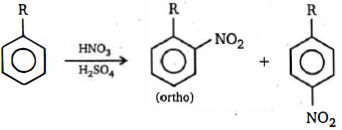
  • $R = - CH_3$
  • B
    $R = - CH_2 -CH_3$
  • C
    $R = - CHMe_2$
  • D
    $R = - CMe_3$

Answer

Correct option: A.
$R = - CH_3$
a
$(a)$ The steric demand of $H^{\ominus}$  is, however extremely small, and  when attack on $C_6H_5Y$ is by any other electrophile, $E^{\oplus}$ , which  will necessarily be larger, there will be increasing interaction between $E$ and $Y$ in the transition state for attack at the position $o-$ to $Y (57 \,b, R = E)$  as attacking electrophile and substituent increase in size ; there can be no such interaction in the transition state for $p-$ attack $(57a, R = E)$. This will  be reflected in an increasing $\Delta \,G^+$ for $o-$ attack, a consequently  slower reaction, and the relative proportion of $o-$ product will thus fall as the  size of $E$ and / or $Y$ increase. This is illustrated by the falling $f_{o^-} /f_{p^-}$ ratios which are  observed for the nitration of alkylbenzenes $(Y ---CH_3 \to CMe_3)$ under comparable conditions ; 

Increase in size of $Y$ $\begin{gathered}
   \downarrow  \hfill \\
   \downarrow  \hfill \\
   \downarrow  \hfill \\
   \downarrow  \hfill \\
   \downarrow  \hfill \\ 
\end{gathered} $ $\begin{array}{*{20}{c}}
  Y&{\% \,\,o - }&{\% \,p\, - } \\ 
  {C{H_3}}&{58}&{37} \\ 
  {C{H_2}Me}&{45}&{49} \\ 
  {CHM{e_2}}&{30}&{62} \\ 
  {CM{e_3}}&{16}&{73} 
\end{array}$

Need a full question paper?

Generate a complete, print-ready paper with questions like this in minutes — across 16+ boards, with answer keys.
Start Generating Free