MCQ
In the above reaction '$X$' stands for
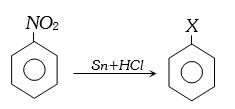
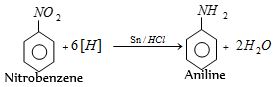
- ✓$N{H_2}$
- B$SnC{l_2}$
- C$Cl$
- D$NH_4^ + C{l^ - }$
Generate a complete, print-ready paper with questions like this in minutes — across 16+ boards, with answer keys.
$(I)$ $\begin{matrix}
\begin{matrix}
\,\,\,Br \\
| \\
\end{matrix} \\
Ph-C-Ph \\
| \\
\,\,\,\,\,\,C{{H}_{3}} \\
\end{matrix}$
$(II)$ $\begin{matrix}
Br \\
|\,\,\, \\
Ph-CH-Ph \\
\end{matrix}$
$(III)$ $\begin{matrix}
Ph-CH-C{{H}_{3}} \\
|\,\,\,\,\,\,\, \\
Br\,\,\,\,\,\, \\
\end{matrix}$
$(IV)$ $PhVH_2Br$
$Cl_2(aq) + H_2S(aq) \to S(s) + 2H^+(aq) + 2Cl^-(aq)$ rate law is $r = K[Cl_2][H_2S]$
then which of these mechanism is/are consistent with this rate law
$(A)\, H_2S \rightleftharpoons H^+ + HS^-$ (fast)
$Cl_2 + HS^-\to 2Cl^-+ H^+ + S$ (slow)
$(B)\, Cl_2 + H_2S \to H^+ + Cl^-+ Cl^+ + HS^-$ (slow)
$Cl^+ + HS^-\to H^+ + Cl^-+ S$ (fast)