Question
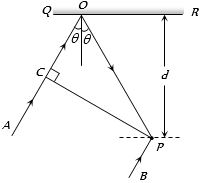
In the adjacent diagram,$ CP$ represents a wavefront and $AO$ & $BP$, the corresponding two rays. Find the condition on $\theta$ for constructive interference at $P$ between the ray $BP$ and reflected ray $OP$
Answer

(b)$PR = d ==> PO = d sec \theta$ and $CO = PO\, cos\, 2 \theta = d \,sec \theta \cos 2 \theta $ is

Path difference between the two rays
$\Delta = CO + PO = (d \,sec \theta  + d\, sec\, \theta \,cos\, 2 \theta )$
Phase difference between the two rays is
$\phi = \pi$ (One is reflected, while another is direct)
Therefore condition for constructive interference should be $\Delta = \frac{\lambda }{2},\frac{{3\lambda }}{2}......$
or $d\sec \theta (1 + \cos 2\theta ) = \frac{\lambda }{2}$
or $\frac{d}{{\cos \theta }}(2{\cos ^2}\theta ) = \frac{\lambda }{2}$ ==> $\cos \theta = \frac{\lambda }{{4d}}$

Need a full question paper?

Generate a complete, print-ready paper with questions like this in minutes — across 16+ boards, with answer keys.
Start Generating Free

Similar questions

A cricket ball of mass $250\, g$ collides with a bat with velocity $10 \,m/s$ and returns with the same velocity within $0.01 \,second$. The force acted on bat is ....... $N$
Four harmonic waves of equal frequencies and equal intensities $I_0$ have phase angles $0, \pi / 3,2 \pi / 3$ and $\pi$. When they are superposed, the intensity of the resulting wave is $nI _0$. The value of $n$ is
The fundamental frequency of a sonometre wire is $n.$ If its radius is doubled and its tension becomes half, the material of the wire remains same, the new fundamental frequency will be
The grinding stone of a flour mill is rotating at $600\, rad/sec$. for this power of  $1.2\, k\, watt$ is used. the effective torque on stone in $N-m$ will be
Consider two $npn$ transistors as shown in figure. If $0\,Volts$ corresponds to false and $5\, Volts$ correspond to true then the output at $C$ corresponds to
A ball of mass $m$ and radius $ r $ is gently released in a viscous liquid. The mass of the liquid displaced by it is $m' $ such that $m > m'$. The terminal velocity is proportional to
If the distance between two masses is doubled, the gravitational attraction between them
When unit mass of water boils to become steam at $100\,^0C$, it absorbs $Q$ amount of heat. The densities of water and steam at $100\,^0C$ are $\rho_1$ and $\rho_2$ respectively and the atmospheric pressure is $p_0$. The increase in internal energy of the water is 
If $|\vec A \times \vec B| = \sqrt 3 \vec A.\vec B,$ then the value of$|\vec A + \vec B|$ is
A particle at a distance of $1 m$ from the origin starts moving, such that $d r / d \theta=r$, where $r$ and $\theta$ are polar co-ordinates. Then, the angle between resultant velocity and tangential velocity is