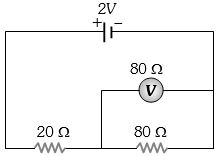
In the adjoining circuit, the $e.m.f.$ of the cell is $2\, volt$ and the internal resistance is negligible. The resistance of the voltmeter is $80 \,ohm$. The reading of the voltmeter will be ............. $volt$
Medium
Download our app for free and get started
(c) Total resistance of the circuit $ = \frac{{80}}{2} + 20 = 60\,\Omega $
$ \Rightarrow $ Main current $i = \frac{2}{{60}} = \frac{1}{{30}}A$
Combination of voltmeter and $80$ $\Omega$ resistance is connected in series with $20$ $\Omega$, so current through $20$ $\Omega$ and this combination will be same $ = \frac{1}{{30}}A$.
Since the resistance of voltmeter is also $80$ $\Omega$, so this current is equally distributed in $80$ $\Omega$ resistance and voltmeter (i.e.$\frac{1}{{60}}A$ through each)
$P.D.$ across $80$ $\Omega$ resistance $ = \frac{1}{{60}} \times 80 = 1.33\,V$
$ \Rightarrow $ Main current $i = \frac{2}{{60}} = \frac{1}{{30}}A$
Combination of voltmeter and $80$ $\Omega$ resistance is connected in series with $20$ $\Omega$, so current through $20$ $\Omega$ and this combination will be same $ = \frac{1}{{30}}A$.
Since the resistance of voltmeter is also $80$ $\Omega$, so this current is equally distributed in $80$ $\Omega$ resistance and voltmeter (i.e.$\frac{1}{{60}}A$ through each)
$P.D.$ across $80$ $\Omega$ resistance $ = \frac{1}{{60}} \times 80 = 1.33\,V$

Download our appand get started for free
Experience the future of education. Simply download our apps or reach out to us for more information. Let's shape the future of learning together!No signup needed.*
Similar Questions
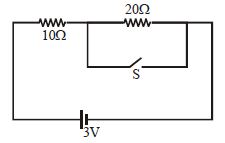
- 1Consider the circuit shown in fig. The current through the $10\,\Omega $ resistor when switch $'s'$ is $(a)$ open $(b)$ closed.View Solution
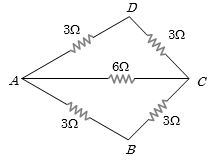
- 2The effective resistance between the points $A$ and $B$ in the figure is ............. $\Omega$View Solution
- 3Two resistances are connected in two gaps of a meter bridge. The balance point is $20\, cm$ from the zero end. A resistance of $15\, ohms$ is connected in series with the smaller of the two. The null point shifts to $40\, cm$. The value of the smaller resistance in $ohms$ isView Solution
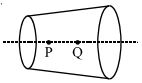
- 4A wire has a non-uniform cross-section as shown in figure.A steady current flows through it. The drift speed of electrons at points $P$ and $q$ is $v_P$ and $v_Q$.View Solution
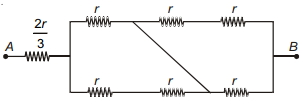
- 5The effective resistance of the network between points $A$ and $B$ isView Solution
- 6View SolutionThe brightness of a bulb will be reduced, if a resistance is connected in
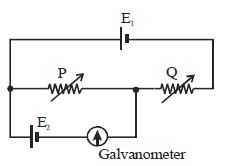
- 7Two cells of $e.m.f.$ $s\, E_1$ and $E_2$ and of negligible internal resistances are connected with two variable resistors as shown in Fig. When the galvanometer shows no deflection, the values of the resistances are $P$ and $Q$. What is the value of the ratio $E_2/E_1$ ?View Solution
- 8View SolutionA conductor behaves as a superconductor
- 9The number density of free electrons in copper is nearly $8 \times 10^{28}\,m ^{-3} . A$ copper wire has its area of cross section $=2 \times 10^{-6}\,m ^2$ and is carrying a current of $3.2\,A$. The drift speed of the electrons is $.....\times 10^{-6}\,ms ^{-1}$.View Solution
- 10In a potentiometer, the null point is received at $7^{th}$ wire. If now we have to change the null point at $9^{th}$ wire, what should we do ?View Solution