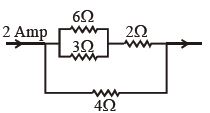
In the adjoining circuit, the potential difference across $3\,\,\Omega $ is ................ $\mathrm{V}$
Medium


Download our appand get started for free
Experience the future of education. Simply download our apps or reach out to us for more information. Let's shape the future of learning together!No signup needed.*
Similar Questions
- 1Two conductors made of the same material are connected across a common potential difference. Conductor $A$ has twice the diameter and twice the length of conductor $B$. The power delivered to the two conductors ${P_A}$ and ${P_B}$ respectively is such that ${P_A}/{P_B}$ equals toView Solution
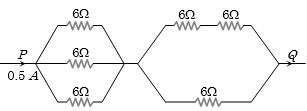
- 2Resistances of $6\, ohm$ each are connected in the manner shown in adjoining figure. With the current $0.5\,ampere$ as shown in figure, the potential difference ${V_P} - {V_Q}$ is .............. $V$View Solution
- 3On an electric heater $220\, volt$ and $1100\, watt$ are marked. On using it for $4$ hours, the energy consumed in $kWh$ will beView Solution
- 4View SolutionThe resistance of a conductor increases with
- 5A wire of resitance $R$ and length $L$ is cut into $5$ equal part. if these parts are joined parts are joined paralley, than result resistance will be:View Solution
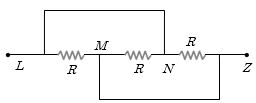
- 6Three equal resistances each of value $R$ are joined as shown in the figure. The equivalent resistance between $M$ and $N$ isView Solution
- 7View SolutionWhich of the following has a negative temperature coefficient
- 8A battery of $e.m.f.$ $10\, V$ and internal resistance $0.5\, ohm$ is connected across a variable resistance $R$. The value of $R$ for which the power delivered in it is maximum is given by ......... $ohm$View Solution
- 9Two wires $A$ and $B$ of same material and mass have their lengths in the ratio $1 : 2$. On connecting them to the same source, the rate of heat dissipation in $B$ is found to be $5\,W$. The rate of heat dissipation in $A$ is............ $W$View Solution
- 10In a meter bridge, the balancing length from the left end (standard resistance of $1 \,ohm$ is in the right gap) is found to be $20\, cm$. The value of the unknown resistance is ............... $\Omega$View Solution