Question
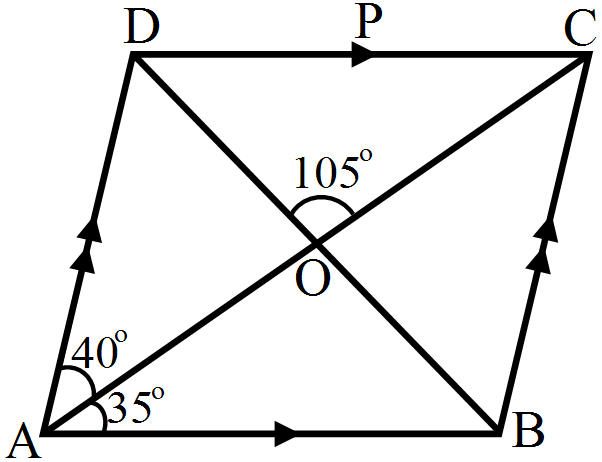
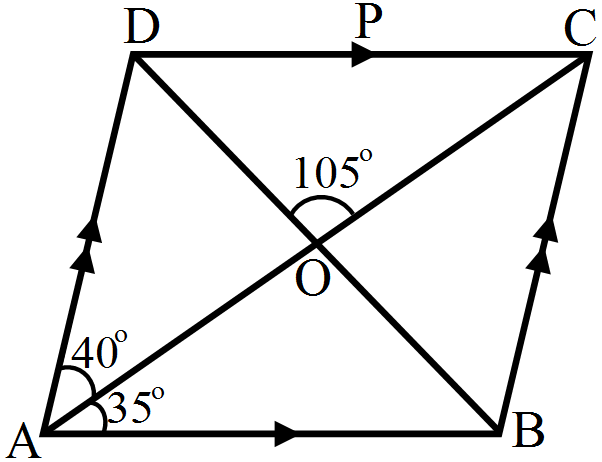
In the adjoining figure, $\text{ABCD}$ is a parallelogram in which $\angle\text{BAO}=35^{\circ},\angle\text{DAO}=40^{\circ}$ and $\angle\text{COD}=150^{\circ}.$ Calculate
$i. \angle\text{ABO},$
$ii. \angle\text{ODC},$
$iii. \angle\text{ACB},$
$iv. \angle\text{CBD}.$
Answer

$\text{ABCD}$ is a parallelogram

$i. \angle\text{AOB}=\angle\text{COB}=105^{\circ} [$Vertical opposite angels$]$
Now in $\triangle\text{AOB},$ we have
$\angle\text{OAB}+\angle\text{AOB}+\angle\text{ABO}=180^{\circ}$
$\Rightarrow35^{\circ}+105^{\circ}+\angle\text{ABO}=180^{\circ}$
$\Rightarrow140^{\circ}+\angle\text{ABO}=180^{\circ}$
$\Rightarrow\angle\text{ABO}=180^{\circ}-140^{\circ}=40^{\circ}.$
$ii.$ Since $AB\ \|\ DC$ and $BD$ is a transversal
So, $\angle\text{ABD}=\angle\text{CDB} [$alternate angles$]$
$\Rightarrow\angle\text{CDO}=\angle\text{CDB}=\angle\text{ABD}=\angle\text{ABO}=40^{\circ}$
$\therefore\angle\text{ODC}=40^{\circ}$
$iii.$ As $AB\ \|\ CD$ and $AC$ is a transversal
So, $\angle\text{ACB}=\angle\text{DAC}=40^{\circ} [$alternate opposite angles$]$
$iv. \angle\text{CBD}=\angle\text{B}-\angle\text{ABO}$
But, $\angle\text{A}+\angle\text{B}+\angle\text{C}+\angle\text{D}=360^{\circ}[\because
\text{ABCD}$ is a parrellogram$]$
$\Rightarrow2\angle\text{A}+2\angle\text{B}=360^{\circ}$
$\Rightarrow2\times(40^{\circ}+35^{\circ})+2\angle\text{B}=360^{\circ}$
$\Rightarrow150^{\circ}+2\angle\text{B}=360^{\circ}$
$\Rightarrow2\angle\text{B}=360^{\circ}-150^{\circ}=210^{\circ}$
$\Rightarrow\angle\text{B}=\frac{210^{\circ}}{2}=105^{\circ}$
and $\angle\text{CBD}=\angle\text{B}-\angle\text{ABO}$
$=105^{\circ}-40^{\circ}=65^{\circ}$
$\angle\text{CBD}=65^{\circ}$

Need a full question paper?

Generate a complete, print-ready paper with questions like this in minutes — across 16+ boards, with answer keys.

Start Generating Free

Similar questions

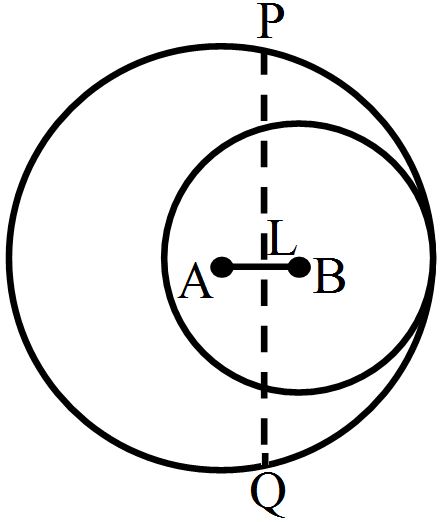
In the adjoining figure, two circles with centres at $A$ and $B$ , and of radii $5\  cm$ and $3\ cm$ touch each other internally. If the perpendicular bisector of $A B$ meets the bigger circle in $P$ and $Q$, find the length of $P Q$.
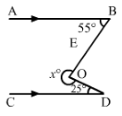
In each of the figures given below, $A B \| C D$. Find the value of $x^{\circ}$
Image
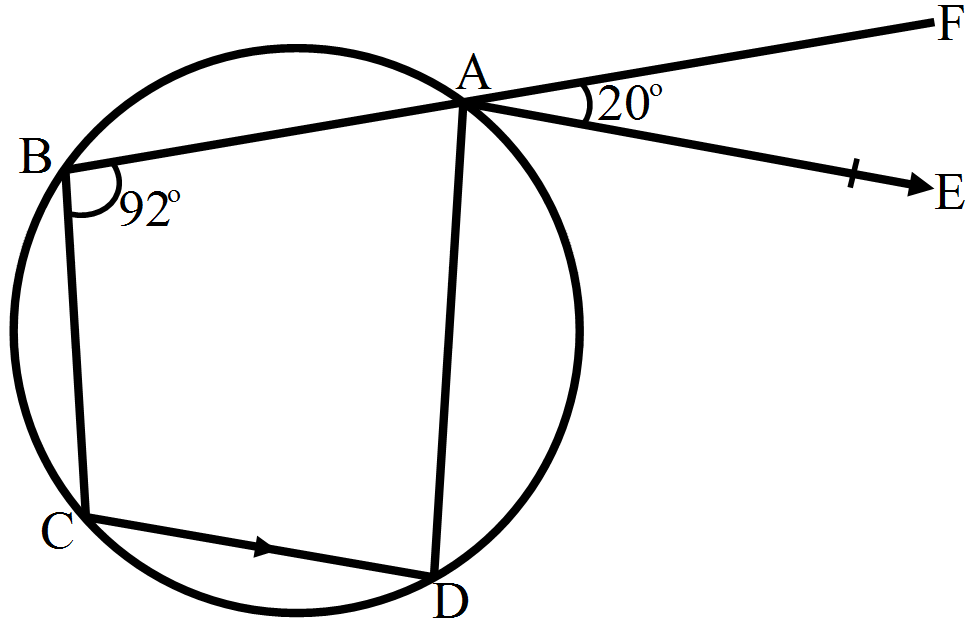
In the given figure, $ABCD$ is a cyclic quadrilateral in which $AE$ is drawn parallel to $CD$, and $BA$ is produced. If $\angle\text{ABC}=92^\circ$ and $\angle\text{FAE}=20^\circ,$ find $\angle\text{BCD}.$
A cylinder and a cone have equal radii of their bases and equal heights. If their curved surface areas are in the ratio $8 : 5$, show that the radius and height of each has the ratio $3 : 4$.
Simplify: $(a + b + c)^2 + (a - b + c)^2 + (a + b - c)^2$
The lengths of 62 leaves of a plant are measured in millimetres and the data is represented in the following table:
Length (in mm)Number of leaves
118-1268
127-13510
136-14412
144-15317
154-1627
163-1715
172-1803
Number of leaves
The following table gives the quantity of goods (in crores of rupees)
Year
$1950–51$
$1960–61$
$1965–66$
$1970–71$
$1980–81$
$1982–83$
Quantity of goods (in crore tonnes)
$9$
$16$
$20$
$20$
$22$
$26$
Represent this information with the help of a bar graph.
An equilateral triangle of side $9\ cm$ is inscribed in a circle. Find the radius of the circle.
Three girls Reshma, Salma and Mandip are playing a game by standing on a circle of radius $5 \ m$ drawn in a park. Reshma throws a ball to Salma. Salma to Mandip, Mandip to Reshma. If the distance between Reshma and Salma and between Salma and Mandip is $6 \ m$ each, what is the distance between Reshma and Mandip?
The factors of $x^4 + x^2 + 25$ are: