Question
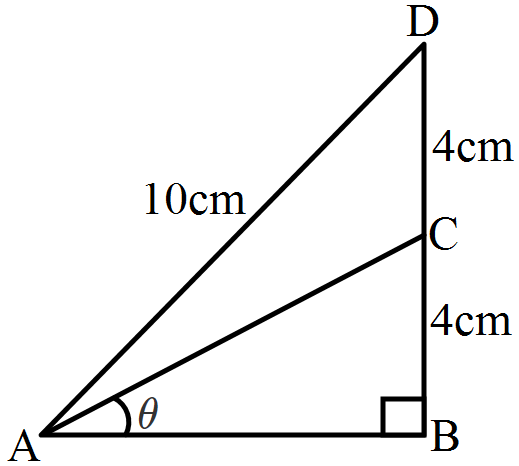
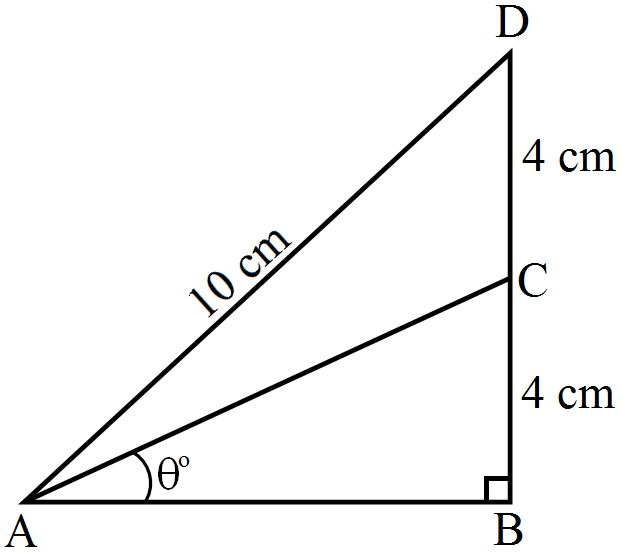
In the adjoining figure, $\angle\text{B}=90^\circ,\angle\text{BAC}=\theta,\text{BC}=\text{CD}=4\text{cm}$ and AD = 10cm. Find
  1. $\sin\theta$
  2. $\cos\theta.$
Hint: $\text{AB}^2=\big(\text{AD}^2-\text{BD}^2\big)=36\text{cm}^2$ $\therefore\text{AB}=6\text{cm}.$ $\text{AC}^2=\big(\text{AB}^2+\text{BC}^2\big)=52\text{cm}^2$ $\therefore\text{AC}=2\sqrt{13}\text{cm}.$ Thus, AB = 6cm and $\text{AC}=2\sqrt{13}\text{cm}.$

Answer


In $\triangle\text{ABC},$ $\angle\text{B}=90^\circ$
$\text{AD}=10\text{cm}$
$\text{BD}=\text{BC}+\text{CD}$
$=4+4=8\text{cm}$
By pythagoras theoram, we have
$\text{AB}^2 = \text{AD}^2 - \text{BD}^2$
$=10^2-8^2=100-64=36$
$\Rightarrow\text{AB}=6\text{cm}$
Now, in $\triangle\text{ABC},\angle\text{B}=90^\circ.$
By Pythagoras theorem, we have
$\text{AC}^2 = \text{AB}^2 - \text{BC}^2$
$=6^2+4^2=36+16=52$
$\Rightarrow\text{AC}=2\sqrt{13}\text{cm}$
  1. $\sin\theta=\frac{\text{Perpendicular}}{\text{Hypotenuse}}$
$=\frac{\text{BC}}{\text{AC}}=\frac{4}{2\sqrt{13}}=\frac{2}{\sqrt{13}}=\frac{2\sqrt{13}}{13}$
  1. $\cos\theta=\frac{\text{Base}}{\text{Hypotenuse}}$
$=\frac{\text{AB}}{\text{AC}}=\frac{6}{2\sqrt{13}}=\frac{3}{\sqrt{13}}=\frac{3\sqrt{13}}{13}.$

Need a full question paper?

Generate a complete, print-ready paper with questions like this in minutes — across 16+ boards, with answer keys.

Start Generating Free

Similar questions

A chord of a circle of radius 30cm makes an angle of 60° at the centre of the circle. Find the areas of the minor and major segments. $[\text{Take }\pi=3.14\text{ and }\sqrt{3}=1.732]$
Prove the following identities:
$\frac{\sin\theta}{(1+\cos\theta)}+\frac{(1+\cos^2\theta)}{\sin\theta}=2\text{cosec}\theta$
Find the area of quadrilateral $ABCD$ whose vertices are $A(-3, -1), B(-2, -4), C(4, -1)$ and $D(3, 4)$.
The following table shows the percentages of demands for different fruits registered with a fruit vendor. Show the information by a pie diagram.
A box contains 36 cards, bearing only one number from 1 to 36 on each. If one card is
drawn at random, find the probability of an event that the card drawn bears,
(i) a complete square number.
(ii) a prime number.
(iii)a number divisible by 3.
A two-digit number is 4 times the sum of its digits. If 18 is added to the number, the digits are reversed. Find the number.
If $\tan\theta=\frac{1}{\sqrt{7}},$ show that $\frac{\big(\text{coses}^2\theta-\sec^2\theta\big)}{\big(\text{cosec}^2\theta+\sec^2\theta\big)}=\frac34.$
The following table shows the classification of percentages of marks of students and the number of students. Draw a frequency polygon from the table.
The sum of two number $a$ and $b$ is $15$, and the sum of their reciprocals $\frac{1}{\text{a}}$ and $\frac{1}{\text{b}}$ is $\frac{3}{10}.$ Find the numbers a and b.
A number consists of two digits. When it is divided by the sum of its digits, the quotient is 6 with no remainder. When the number is diminished by 9, the digits are reversed. Find the number.