Question
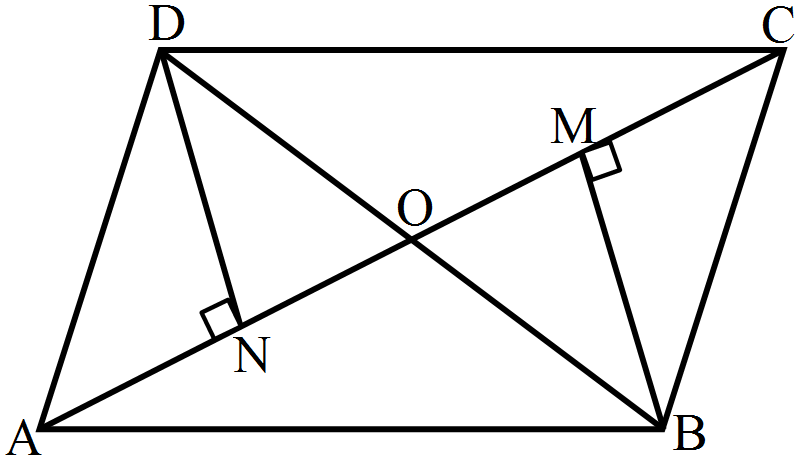
In the adjoining figure, $\text{BM}\perp\text{AC}$ and $\text{DN}\perp\text{AC}.$ If $BM = DN$, prove that $AC$ bisects $BD$.
Answer

Given: $A$ quadrilateral $ABCD$, in which $\text{BM}\perp\text{AC}$ and $\text{DN}\perp\text{AC}$ and $BM = DN$.
To prove: $AC$ bisects $BD$; or $DO = BO$
 Proof: Let $AC$ and $BD$ intersect at $O$.
Now, in $\triangle\text{OND}$ and $\triangle\text{OMB},$
we have: $\angle\text{OND}=\angle\text{OMB}$ (90° each) $\angle\text{DON}=\angle\text{BOM}$ (Vertically opposite angles)
Also, $\text{DN = BM}$ (Given) i.e., $\triangle\text{OND}\cong\triangle\text{OMB}$ (AAS congrurence rule)
$\therefore\text{OD = OB}$ $(C.P.C.T.) $
Hence, $AC$ bisects $BD$.

Need a full question paper?

Generate a complete, print-ready paper with questions like this in minutes — across 16+ boards, with answer keys.
Start Generating Free

Similar questions

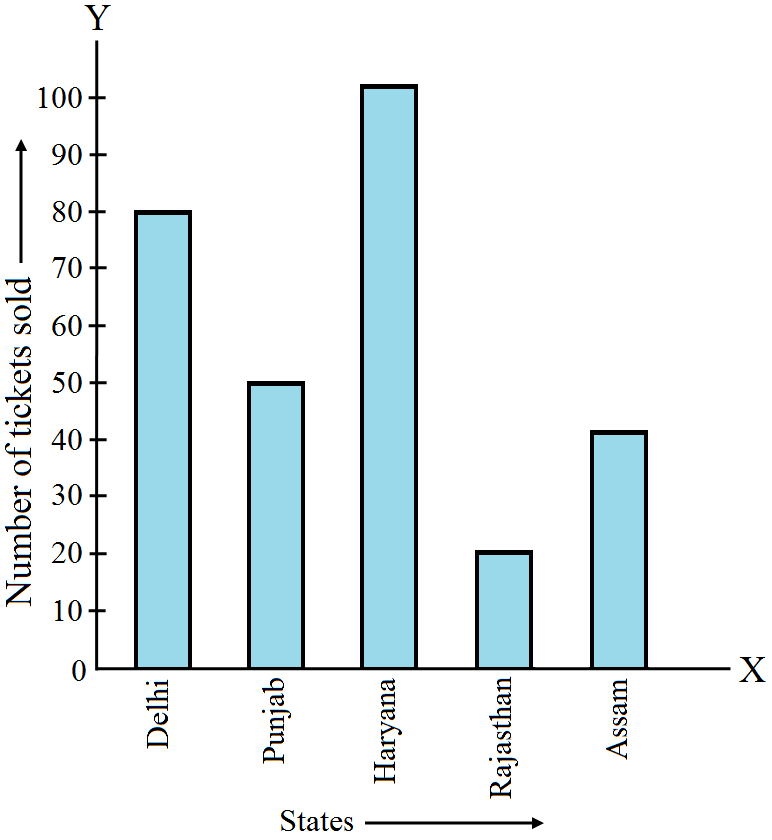
Read the bar graph shown in the figure and answer the following questions:

$i.$ What is the information given by the bar graph?
$ii.$ How many tickets of Assam State Lottery were sold by the agent?
$iii.$ Of which state, were the maximum number of tickets sold?
$iv.$ State whether true or false.
The maximum number of tickets sold is three times the minimum number of tickets sold
$v.$ Of which state were the minimum numbers of tickets sold?
Find the missing frequency $(p)$ for the following distribution whose mean is $7.68$
x:
$3$
$5$
$7$
$9$
$11$
$13$
f:
$6$
$8$
$15$
$p$
$8$
$4$
$ABC$ is a Triangle. $D$ is a point on Ab such that $\text{AD}=\frac{1}{4}\text{AD}$ and $E$ is a point on $AC$ such that $\text{AE}=\frac{1}{4}\text{AC.}$ prove that $\text{DE}=\frac{1}{4}\text{BC}.$
A chord of a circle is equal to its radius. Find the angle subtended by this chord at a point in major segment.
Find the missing value of $p$ for the following distribution whose mean is $12.58$.
x:
$5$
$8$
$10$
$12$
$p$
$20$
$25$
f:
$2$
$5$
$8$
$22$
$7$
$4$
$2$
Without actual division, prove that $2x^4 - 5x^3 + 2x^2 - x + 2$ is divisible by $x^2 - 3x + 2.$
Draw the graphs of the following linear equations on the same graph paper: $2x + 3y = 12, x - y = 1$ Find the coordinates of the vertices of the triangle formed by the two straight lines and the $y$-axis. Also, find the area of the triangle.
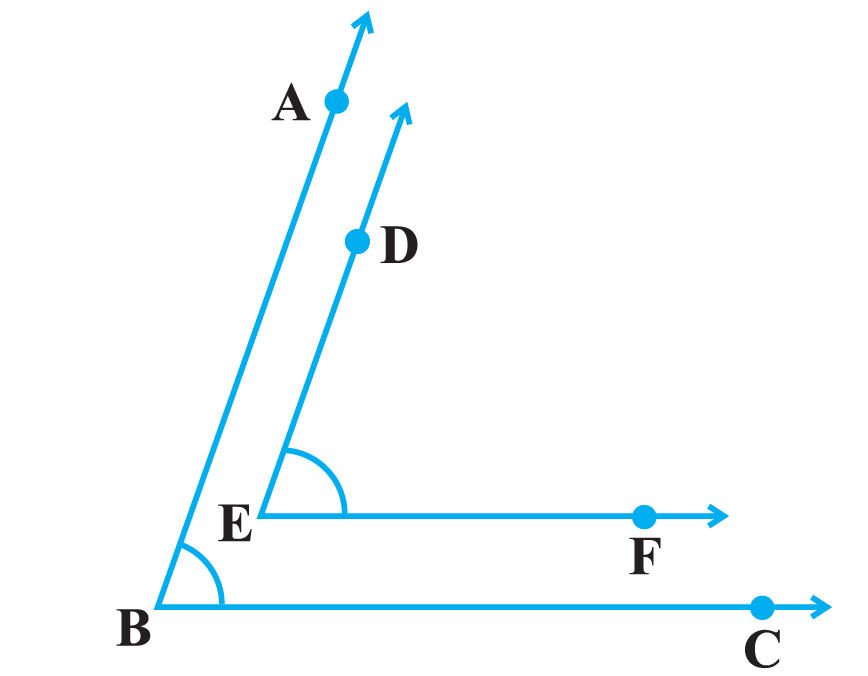
In Fig. $\text{BA}||\text{ED}$ and $\text{BC}||\text{EF}$ . Show that $\angle\text{ABC}=\angle\text{DEF}$
[Hint: Produce $DE$ to intersect $BC$ at $P$ (say)].
If $a - b = 5$ and $ab = 12$, find the value of $a^2 + b^2.$
$P$ is point on the bisector of $\angle\text{ABC}.$ if the line throught $P,$ parallel to $BA$ meet $BC$ at $Q,$ prove that $BPQ$ is an isosceles triangle.